


Page: 1 2
In fact, similar happened personally. I got to choose between seven brand new hd28s. Still in the bags from Martin. I had a seventeen year old salesman assisting. The fellow did know his guitars. We unbagged and tuned up each one. We had all the time we wanted. We were both having a good time. I said to him, "which one?" We both picked one, same unit that was strangley head and shoulders above the others, as far as tone and projection. We thought it was very unusual, as Martin is notoriously uniform. IOW, it's hard to find a bad one. That m-f unit came home with me. I can tell you, this unit sounds great even with old strings. One wouldn't think it's much different from an HD35, but side by side, both with medium Martin strings. They are different animals.


Working in a shop that did wholesale to 50 or so shops around the country, I got to see thousands of violins that were pretty near identical, from the same wood source down to the selection of only one-piece backs. To improve their consistency, each one was taken apart and regraduated and given a good bassbar, then varnished and set up by only one person. Every violin was played before it got a label because they weren’t allowed out the door if they didn’t sound good enough or weren’t pretty enough (they’d get a cheaper label if they were inferior). But even then, every once in a while there would be a few that were just astonishingly good. The owner would always call those fiddles “motherines,” and they would be set aside for special purposes.
quote:
Originally posted by The Violin BeautifulWorking in a shop that did wholesale to 50 or so shops around the country, I got to see thousands of violins that were pretty near identical, from the same wood source down to the selection of only one-piece backs. To improve their consistency, each one was taken apart and regraduated and given a good bassbar, then varnished and set up by only one person. Every violin was played before it got a label because they weren’t allowed out the door if they didn’t sound good enough or weren’t pretty enough (they’d get a cheaper label if they were inferior). But even then, every once in a while there would be a few that were just astonishingly good. The owner would always call those fiddles “motherines,” and they would be set aside for special purposes.
That’s the kind of fiddle we all want to have
Suitable for Memorial weekend, to remember Pogo.
He had a turn of a phrase:
"Sometimes you find a fiddle that 'punches above it's weight.'"
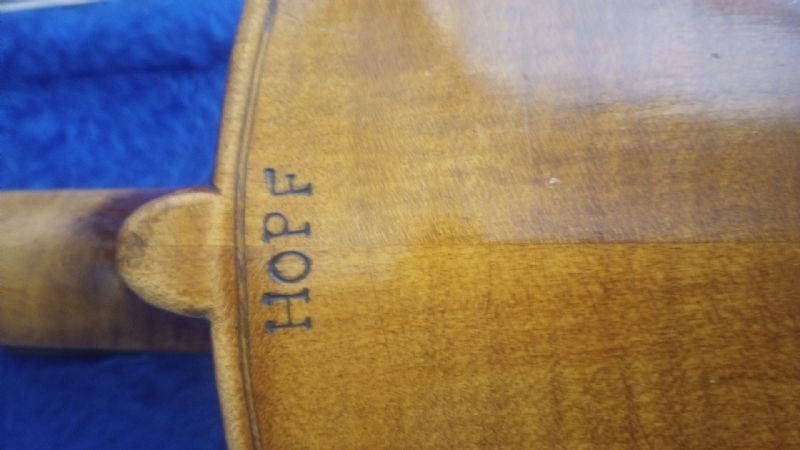
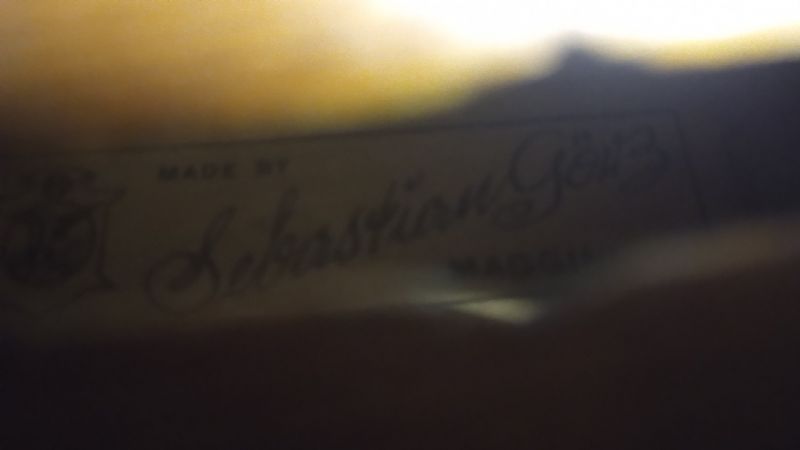
I have a Maggini copy Hopf. It didn't standout at all, until I slacked the strings. That fiddle loves DGCF.
farmerjones - What is "a Maggini copy Hopf?" That seems like a contradiction in terms.
quote:
Originally posted by DougDfarmerjones - What is "a Maggini copy Hopf?" That seems like a contradiction in terms.
Says Maggini on the label. Says HOPF on the heel. It's gotta double row of purfling.
You want pictures? I'm sure it worth tens of dollars.
Edited by - farmerjones on 05/23/2026 17:09:07
When you double the purfling you also double the fun and that’s a well known fact.
Seriously though, I have an old violin with crooked purfling. I wouldn’t want a doubling of that.
The sites spell check/correct changed purfling the first time to pudding and the second time to peddling.
Well, I could've had some fun with this, but someone would see the Hopf didn't have double purfling.
They're in the same bucket.
Violins made in the Klingenthal, Saxony, and Markneukirchen cottage industry were often given a Hopf brand below the button. These were not the same as the older violins made by members of the Hopf family, but the brand was a way to associate the name. It sounds odd to see a brand and label that don’t match, but this isn’t as uncommon as you might expect.
Brands were also used by dealers sometimes to add a detail to a violin in order to give a name to a violin that was otherwise anonymous. Some of the brands were sold to people who used them long after the fact to do the same.
Same thing happened when I bought my Martin. I had the kid in the store keep bringing up fresh ones until 1 just jumped out of the crowd - amazingly better than the rest. Still has that quality to this day.
When you’re using a natural product like wood to make such a complicated acoustic system, there will be some variation no matter how similar you make them. This is why CNC-made plates don’t yield identical results even though they can be machined to very narrow tolerances.
My great-great grandfather had a large log of maple that he used to make some of his violins. The wood is immediately recognizable visually, but the sound of the violins is quite different, even when the same form was used.
One of the most eye-opening lectures I’ve attended was at the Oberlin Acoustics workshop. An acoustics analyst for Boeing who had become enthralled by the complexity of the violin described an experiment for tonal analysis wherein a machined product with a hollow body—the beer can—was analyzed by taking a reading of 1000 examples. The results were plotted on a spectral analysis graph. Then the readings from 1,000 violins were compared. The result was that the violins, which sounded nothing alike and were made using a wide variety of forms, were far more consistent in terms of their response curves than the machined products that were theoretically far easier to control and were entirely made by machine. This is why there is so much mystery surrounding violin making—you can make some general predictions, but you can’t make the same violin twice. Neither can a machine.
Another complicating factor is that the finer the instrument, the greater the differences that often appear. Cheap violins are often left thick, varnished with a varnish that chokes tone, and set up so poorly that response is inhibited enough to the point that it’s hard to get much out. Damp the response enough and the violins seem a lot more similar. This is why revoicing has such incredible results; fix the things that aren’t working and you can have an instrument that performs much better. However, you can’t clone a sound by revoicing (although there are some cranks who claim to be able to accomplish this).
quote:
Originally posted by The Violin BeautifulThis is why there is so much mystery surrounding violin making—you can make some general predictions, but you can’t make the same violin twice. Neither can a machine.
Is that true with carbon fiber violins?
quote:
Originally posted by Brian Woodquote:
Originally posted by The Violin BeautifulThis is why there is so much mystery surrounding violin making—you can make some general predictions, but you can’t make the same violin twice. Neither can a machine.
Is that true with carbon fiber violins?
My guess is that carbon fiber violins will have some variation but will be much more consistent than wood. I've made a lot of banjos, some out of solid wood some of plywood and some of bamboo. The banjos made of plywood and the banjos made of bamboo are very consistent compared to banjos of solid wood. I avoid making banjos of solid wood.
quote:
Originally posted by Brian Woodquote:
Originally posted by The Violin BeautifulThis is why there is so much mystery surrounding violin making—you can make some general predictions, but you can’t make the same violin twice. Neither can a machine.
Is that true with carbon fiber violins?
I haven't seen any testing of this to have a definitive answer.
In theory, the more man-made a material is, the more its properties can be reproduced and understood. In practice, though, it gets complicated. There's enough variability even in man-made materials that things don't end up completely the same.
Carbon fiber is as much a process as it is a material. By that I mean that things made of that material are produced by layering thin sheets and impregnating them with resin to bond layers, build up thickness, and seal the surface. Layup technology affects results, and so do other parts of the process. Even the choice if resin and its mixture have an effect. You have to have a pretty high quality end production facility to approach consistency.
Based on all the carbon fiber instruments I've seen, I would think of them the same way as the cheap violins--if they sound more alike, it's because they're inhibited enough that the qualities that make for an interesting character in a violin aren't present.
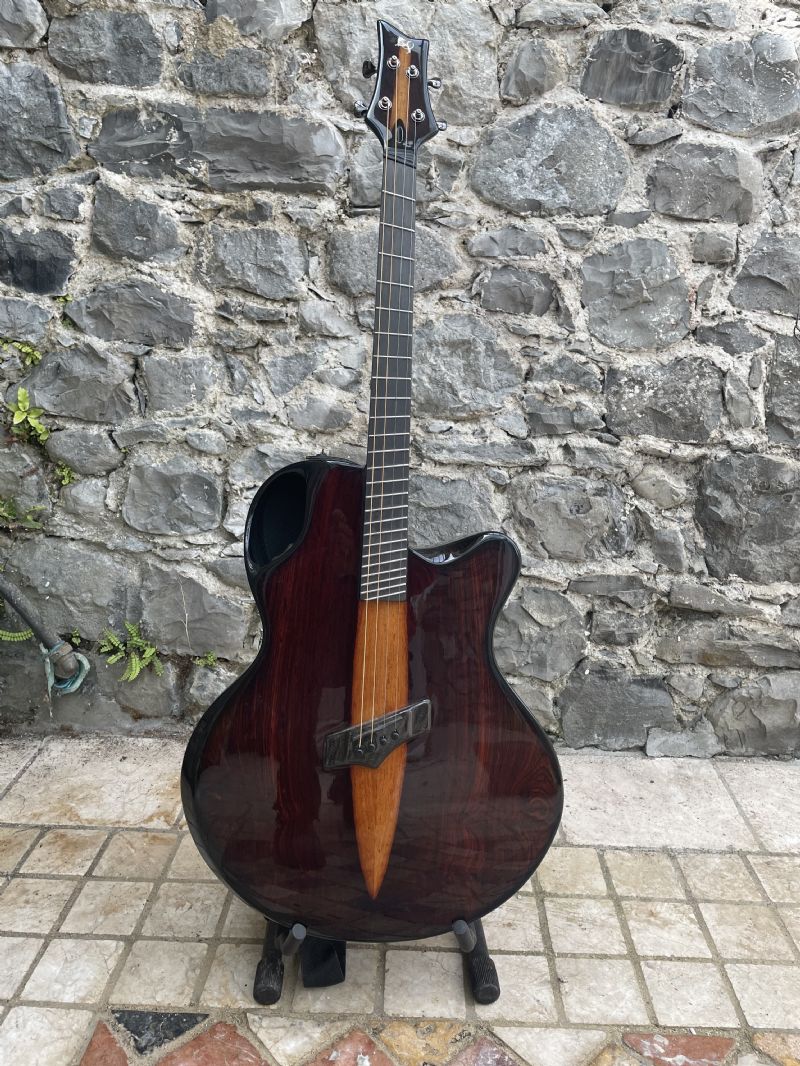
I have a carbon fiber guitar. A custom made tenor guitar from Emerald guitars. It is a beautiful instrument and has the sound to match. What surprised me is that it isn’t particularly loud. Now of course it’s only a sample of one for me because I haven’t come across another.
quote:
Originally posted by martyjoeI have a carbon fiber guitar. A custom made tenor guitar from Emerald guitars. It is a beautiful instrument and has the sound to match. What surprised me is that it isn’t particularly loud. Now of course it’s only a sample of one for me because I haven’t come across another.
I've seen two of them. A friend's just arrived from Ireland recently and he tried it out at a gig. He was surprised by how quiet it was acoustically but was happy with it plugged in, which is how it will mostly be used. Then I was visiting another friend and was invited to play a gig with an old bandmate who happened to have an Emerald as well. He was happy with it but noted it wasn't an especially loud instrument. He told me he had another one at home as well for his studio. I'd never heard of Emerald until my friend told me he was placing the order.
I should revise my earlier statement, though. I should have said carbon fiber bowed string instruments, not all instruments. I thought the Emerald I played with acoustically sounded alright. I haven't heard one, but a few people have said that they really like Ovation guitars as well.
Edited by - The Violin Beautiful on 05/24/2026 17:19:43
Page: 1 2
Terms of Use | Privacy Policy | Privacy Consent (EU/GDPR Only)
Copyright 2026 Fiddle Hangout. All Rights Reserved.