



Page: 1 2
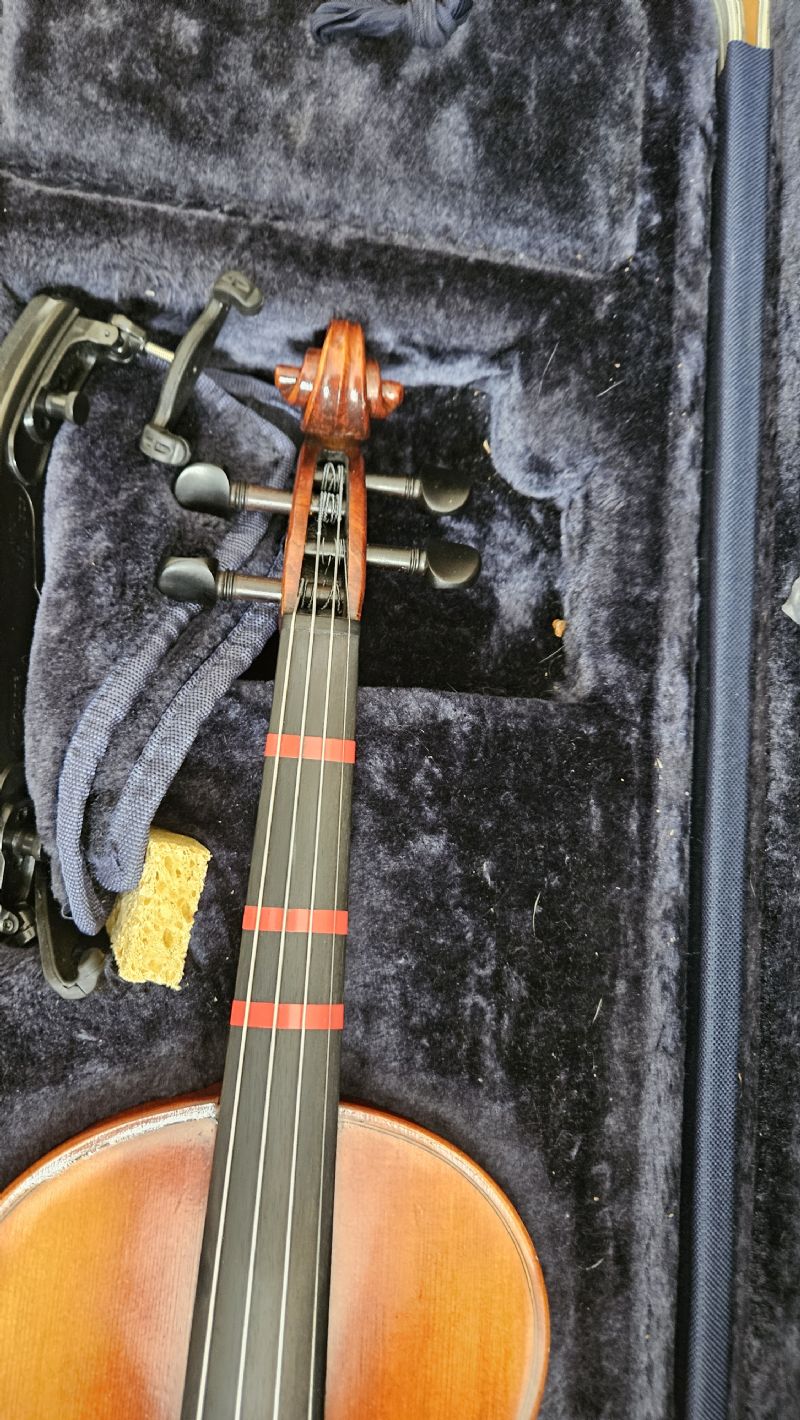
The used student fiddle I started with had tape on 2, 5, and 7. I figured I might as well leave it on as I started to learn to play; I've been playing since late December, about two months. I'm wondering how long I should leave it on and when I should take the plunge and pull it off. Once I take it off, there's likely no going back as I don't have more tape and may not get it positioned correctly if I did.
I try not to peak while playing. If I'm looking, it's mostly to check my bow angle. But it does help getting started, like if I start a song on an F# or an A on the D string.
-Ken

For what it’s worth, I still have tapes. I just replaced the tapes as the original was coming undone. You can look online where to locate them and check your placement with a tuner. I’ve read you can leave them on for 2 years or until you feel comfortable without them. My 2 cents.

If you’re not looking at the tapes to check, you can probably remove them. You may be used to the feel of the tape at those spots, but I would encourage you to put your energy into checking pitch by ear and not relying on the eye or the finger much, if at all. Lots of students learn that way, but the transition to relying on the ear alone can then be more complicated.
Tapes are easy to replace. Any shop can do it for you, especially one with a rental program. Don’t be afraid to take the tapes off if you think you’re ready. If you have a teacher, ask the teacher for an opinion.
The time was yesterday  they are a crutch, and your fingers are likely working pretty good, time to let your ears take over. The ears are far more important than the tape.
Edited by - ChickenMan on 02/25/2025 09:55:50
Tape off! Ears on!!
If it sounds in tune without looking/checking, yup time to take off the “training wheels”! Although probably no harm in leaving longer if you are unsure…
I had tapes for at least the first six months, I think ( as a kid, I did not practice daily though :-)
I know several adult fiddlers whose intonation is so bad, I wish they they had never taken off the tape (if they ever used it in the first place)!
Maybe if You wanted to reinstall them you could try using the StewMac Fret Calculator to find the positions again. I think that you are better off without them.
"When to lose tape on fingerboard"
ideally before you put it there.
I like to play along with recorded music. If a specific note(s) give me trouble, I will use tape until the problem is gone. When playing along with music, I usually play the scale several times first. This approach seems to have taught my ear how to recognize notes and my fingers to finger them accurately. Playing along with recorded music also helps me identify and correct timing problems sometime. The notation in music books seems to keep getting smaller all the time, and lack of spiral binding makes it difficult keeping books open.
Early on I would check my finger placement by bowing an adjacent open string and the fingered string together. Listening for a pleasant interval.
Try sliding a finger up or down a string while bowing an adjacent open string at the same time. You should be able to hear the sliding string come into harmony.
I've always thought it was wrong to wait on learning double-stops and drones. This is what a fretless instrument is all about. Learn to love the fretless-ness. This ain't no mandolin.
I took mine off at about two months when I tried another fiddle (without tape) and found I could still play.
If you wanted you might just leave one on.
When they fall off don't replace them
Edited by - Peghead on 02/26/2025 06:20:51
Since you asked, I say lose the tapes now.........
There are simple exercises to tune up your fingers, F# and A on the D string are a couple of them. The mental focus required to tunes these notes will be required for the rest of your fiddle journey.
If you play other instruments your ears will be tuned up by now.
Ahh..... C'mon you can't see it ... You dont need it at all. If you need that sort of guidance just play mandolin, at least you can look at the frets and the dots on the fingerboard. With fiddle you have to HEAR it. Trying to look at tape on the fingerboard isn't going to help at all.
Just my strongly held opinion though LOL...
Kind of reminds me of question...
When do you lose training wheels on a bicycle?
Simple answer would maybe be - when you don't need them... but part of question if "need" at all.
I never had to address that, as I started without (didn't even know were a thing). Starting out on day one, with part of it involved learn how to balance; probably a bit wobbly at first, stumbled, but just got back on, managed learn how to adjust and correct. How my kids learned as well.
With fiddle, maybe wobbly/stumble, but what's worse can happen; at least never felt had to worry about falling, physical injury, can easily just get back on and adjust.
Never used tape. Never even occurred to me to try.
Learned to ride a bike same way. No training wheels - my uncle ran along side and let go of the bike, and off you went. A whole generation of us learned the same way.
Lose the tape, use the ears.
Recently, I've was playing a tune that required a high c#. I realized that since I removed the tape I had placed on my fingerboard to remind me of that spot I'm hitting the note dead on! SO.. Having had the tape was a great way to train my finger. 50 years of laying and I still appreciate tape..
(original poster) One thing I've noticed with tape on my fingerboard is I pretty much only use it to find the first note or two. Then I stop looking.
I attended the second jam I ever attended last Friday, more of an intermediate jam than the first one I attended, but vocal songs, not fiddle tunes. I was considering taking the tape off after that jam. There were a much greater variety of keys for songs called. Not just G and maybe a few in D. Several other keys I don't have much experience in including at least one that definitely had a minor sound, either E minor or E Dorian. With concentrating so much on just bowing some simple notes that fit the changes, I did find the tape useful to find the first couple notes. I had played to take the tape off after this jam but now I'm thinking I'll give it another jam or two.
Take the damn tape off! I've been playing since 1953. If you are playing A on the D string just play it with the adjacent A string to check it. If you're playing D on the A string play it with the open D to see if they match...Lots of ways to check every note..
Good to hear from you, Eric. I was just wondering about you the other day. Good advice too!
It' s impossible for the tapes to be accurate anyway, because the intonation will depend on the nature of your finger; a fat finger will be in a different place than a thin finger, and the finger pressure will also be a factor. If you know songs that begin with specific intervals you can tune all your fingers to them....
Jaws Theme; minor 2nd, open string to first finger first fret.
Happy Birthday; major 2nd, open string to first finger second fret.
Somewhere My Love; minor 3rd, open string to second finger third fret.
Oh When The Saints; major 3rd, open string to second finger fourth fret.
Amazing Grace; Perfect Fourth, open string to third finger fifth fret.
Twinkle Little Star; perfect fifth, open string to fourth finger seventh fret.
If you prefer to compile your own list of songs, try this site.....
earmaster.com/products/free-to...ator.html
Tune your instrument carefully first and foremost.
Frets are for mandolins and guitars where they do some good. Banjos often benefit from them.
Fiddles don't need them. But, if you must, tape only the perfect 4th interval. That's the ring finger stopping at the octave of the open string below as described earlier in this thread. I've found that establishing that location during a brief warm up before practice makes all the difference in keeping my ears in tune. I do it by ear, though. No tape at all. I also play an open string against the string below stopped with the pinkie, as described above. Should give you a perfect unison.
None of this is much help if my instrument isn't in tune. Do the open strings sound out of tune when I play with others? Either I'm out of tune or my fiddle is. Possibly both. Yet another reason to get out there with your fiddle and play with others.
Re the 7th stop suggestion. I do intend to lose the tape soon. The fiddle I bought used has 2nd, 5th, and 7th stops taped. I've already planned when I take the tape off to lose 2nd first, 5th next, and 7th last.
Rather than actual intonation; I think idea for some folks using tape markers as more general finger/position guide, to help map, comprehend of layout. Like how beginning fretted instrument players look at position marker dots or just counting number of frets, to just able differentiate fourth fret or fifth.. Also bit of reminder, or confidence reassurance.
In their mind, probably not ready to tackle good intonation... they just need something, to get approximate distance or get them in rough ballpark of pitch class.
Edited by - alaskafiddler on 03/26/2025 23:02:24
quote:
Originally posted by learn2turnRe the 7th stop suggestion. I do intend to lose the tape soon. The fiddle I bought used has 2nd, 5th, and 7th stops taped. I've already planned when I take the tape off to lose 2nd first, 5th next, and 7th last.
Good plan. You'll cruise it.
Page: 1 2
Terms of Use | Privacy Policy | Privacy Consent (EU/GDPR Only)
Copyright 2026 Fiddle Hangout. All Rights Reserved.


