


The way I see it, to keep a previous era's music from disappearing into the ether, you gotta both honor the past and honor the present. Sure, pay heed to what the scholars say are historical practices, but remember that the tune emanated from human beings and that human beings basically haven't changed all that much from what they were way back when.
Edited by - Lonesome Fiddler on 03/24/2026 14:01:41


Was not saying that Irish Trad & OT are the same...am very aware of the different styles!
Was saying they are the same in the sense that there are players who descend from families that have a tradition of music in that genre. If you say Irish stuff is still alive due to continuity of playing, that applies to OT too ... because there are people around who are playing the stuff they learned from older players i.e. family or community members, and they are carrying that thread forward into the present (same as with Irish Trad).
quote:
Originally posted by NCnotesWas not saying that Irish Trad & OT are the same...am very aware of the different styles!
Was saying they are the same in the sense that there are players who descend from families that have a tradition of music in that genre. If you say Irish stuff is still alive due to continuity of playing, that applies to OT too ... because there are people around who are playing the stuff they learned from older players i.e. family or community members, and they are carrying that thread forward into the present (same as with Irish Trad).
But even by this logic they aren't the same. Irish music was passed down directly through generations. But Old Time was a style that had its end in the 1940s. When the revival began in the 1960s, the players who had recorded the Old Time discography were gone already.
Fiddle music was played from the time it came to America to the present, but that doesn't make it Old Time. I am saying that the tradition of playing fiddle music was indeed passed down in a manner roughly similar to the transmission of Irish music, and that tradition continued independently of Old Time, a style of music that was a deliberate reinterpretation. So I would also say that during the time the music was being recorded, there were both fiddle music that was Old Time and fiddle music that was traditional fiddle music. When the revival took place and interested people began to listen to both the commercial recordings and field recordings of rural fiddlers playing in the traditional styles, the distinction between the two was lost. The lack of clarity is how we've gotten to the present, where some players play what they call Old Time (whether that's rightly or wrongly done) and others say "That's not Old Time!" without being able to present any kind of rational definition of the genre.
Well ok, but still does not feel "dead" to me, or in danger of extinction..
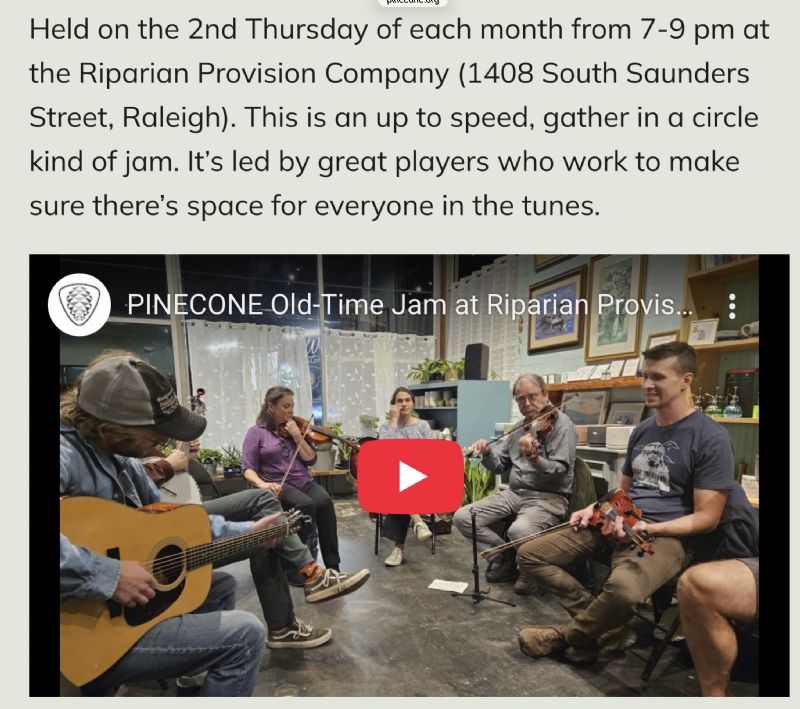
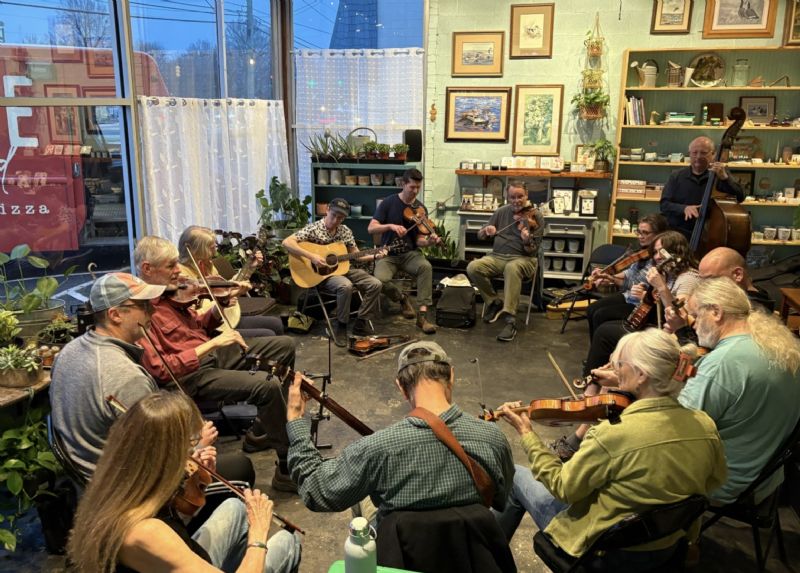
.photos courtesy of Pinecone website:
NCnotes - Did you watch the videos I linked on the previous page? I think better than still pictures (I couldn't get the video to play), although I guess you're showing jam sessions, not bands.
Of course "Old Time" music is thriving in many places, evolving, changing, in the hands of some talented and dedicated musicians.
Edited by - DougD on 03/24/2026 15:49:21
It’s perhaps possible to view it as a thriving genre if you expand the definition so that it includes everything under the sun, but that’s a difficult argument to make when the majority of people still have no idea Old Time exists, there is a noticeable lack of long term youth engagement in most places, and membership on this very forum is decreasing.
And, as I’ve said, I don’t see it as particularly “alive and well” when no one can decide what it is, yet there is a strong feeling that modern players are doing something different. If it’s not true that the playing is different, then there ought to be a way to explain why there is something consistent across time so that those who see it as different can be corrected using solid factual evidence. If it is true that the music is different, then since it has changed so much, it is clear that it is not the same style of playing that was recorded in the defining era, and the modern playing is evidence of new styles that have emerged since.
I started this thread to show an idea about defining the genre from three possible perspectives. I explained why I favored one of them. Thus far no one has actually considered the other two options for definition. It would be interesting to see if there could be a rational argument for them.
I should likely apologize for jumping in here after 6 pages (2, 3, 4 and 5 not read), and offer my 2 cents, but apparently I can’t help myself. For those of us who have done sufficient listening to the genre, identifying the style isn’t at all difficult - we know it when we hear it. After a while, it becomes possible to listen to a performance and understand it as authentic, or another and know that the player is attempting to take the music in a slightly different direction, a modern take, or even a completely different thing like bluegrass, etc.
I wouldn’t be at all surprised, that if a blind test were conducted with say, 20 seasoned old-time enthusiasts (pulled from this site), and those 20 were asked to listen to clips from various fiddle oriented genres, that a fairly strong consensus among the 20 would be found - they would generally agree with each other as to which clips were “old-time”.
quote:
Originally posted by JohnbowI should likely apologize for jumping in here after 6 pages (2, 3, 4 and 5 not read), and offer my 2 cents, but apparently I can’t help myself. For those of us who have done sufficient listening to the genre, identifying the style isn’t at all difficult - we know it when we hear it. After a while, it becomes possible to listen to a performance and understand it as authentic, or another and know that the player is attempting to take the music in a slightly different direction, a modern take, or even a completely different thing like bluegrass, etc.
I wouldn’t be at all surprised, that if a blind test were conducted with say, 20 seasoned old-time enthusiasts (pulled from this site), and those 20 were asked to listen to clips from various fiddle oriented genres, that a fairly strong consensus among the 20 would be found - they would generally agree with each other as to which clips were “old-time”.
It would be so convenient if it were really that easy! I would recommend reading the other pages, as I think they show to some extent just how disparate the ideas of the music are and how conflicting they can be. I can agree that a lot of people feel they can recognize Old Time when they hear it, but if you put a few of them together in one place (like a discussion forum) you'll soon find that they all have different takes on it and it becomes a matter of personal opinion, not fact.
Your use of the word "authentic" is entirely reasonable, however, just the utterance or writing of it draws a sharp intake of breath from a lot of people who take issue with the idea of any formal understanding of authenticity. One of the reasons for my starting the thread is that I see so much disagreement over this subject, both over the examples that ought to be used and the very concept of accepting anything as authentic and excluding anything else as its opposite. I encourage you to read the linked article from the first post, especially the section on the strict definition, because it goes into depth on this subject. To arrive at an idea of what's authentic, a great deal must be excluded, and that ruffles feathers.
If you'd be willing to organize an experiment to see whether people could agree on what's authentic, I'd love to see it. I think it would be difficult to set up, though, because your premise would also require there to be agreement on which 20 players ought to be selected. Would professional musicians or former professional musicians be excluded? How long would a player need to play to be considered seasoned? You might have an easier time just selecting clips and conducting a poll to see if there are trends in opinion. Again, polls are not a great way to determine accuracy, but they do show opinions held by members of a group.
Just to put it into perspective, the comparison to Jazz is pertinent because even there people are still not quite in agreement about the definition of the genre. I keep Wynton Marsalis' article "What Jazz Is and Isn't" open in a tab for reference from time to time because it wonderfully describes the ongoing clash and seemingly willful misunderstanding that occurs among listeners. I see such strong parallels with the Old Time crowd.
Edited by - The Violin Beautiful on 03/25/2026 21:56:13
Hi there Rich - if I may call you that. Thank you for your thoughtful reply.
I don’t know that I’m prepared to work much harder than I have so far to make my point - we know it when we hear it. I agree, there will be variance of listener interpretation. It may be that some individuals are better suited (flexible thinking, open minded, experienced, disinterested in being dogmatic, etc.), to take in a performance and “pass judgement”. Perhaps, a final definition is not possible.
I do worry that a definition is impossible, and that is concern for me because I see so many people who are playing various traditional forms of American fiddling dying. At jams I often hear players lament the lack of younger players to keep things moving along.
I don’t think the tunes themselves will necessarily disappear (unless a new trend in fiddling becomes dominant enough to wipe them out), but I fear that with time and as more players move away from playing in traditional styles, the older spirit of the tunes is disappearing.
The comparison to baroque music is made a lot, and I think with good reason. Like Old Time, baroque music had a revival of interest in the mid-20th century. The revival players of baroque music were doing their best to make sense of it but didn’t have the benefit of the deep study that came later as interest in the style and its history grew. Eventually scholarship grew to the point where the playing became both palatable and likely a realistic representation. I think there was a similar thing happening with the Old Time revival—a lot of enthusiasm from the folk revival crowd, but not necessarily an accurate recreation. Unlike the baroque scene, there just hasn’t been the same sort of scholarly approach to Old Time, and I think that it has not enjoyed the same trajectory seen with baroque. With the revival players dying off now and younger players showing a desire to move away from the style of the revival players, it seems to me that the genre is at an important crossroad: it can either head toward the historical, backward-looking approach, or it can divorce itself from history altogether and become a new entity that bears little in keeping with its origins.
My guess is that old time will continue to find its place. Afterall, it really is quite an interesting style of music, as are all the world’s fiddle traditions. I do quite a lot of my music listening via YouTube. As you know, YT tends to promote videos in which it thinks the viewer will be interested. So, from my perspective, there seems to be lots of activity and involvement in the type of music in which I’m interested.
I’ve noticed that a lot of players have just stopped using the term Old Time to describe their music out of frustration with the vagueness of the term. Lately, I’ve heard terms like Round Peak, Appalachian music, and American traditional folk used instead to focus more on a time period or region. Players won’t object of they’re called Old Time players, but they deliberately choose not to use the term to describe themselves.
I was recently listening to an interview with a banjo player who talked about this. As he put it, “The past is over. It’s dead. All the players are dead. I don’t believe you can revive what’s past. What you can do is you can create anew. You can create your own tradition built on what you know, your perception of those past traditions.” The interview was described as an Old Time interview in its title, but the player never used the term Old Time, instead describing himself as a contemporary banjo songster. This is intriguing given his own love of history and traditional styles. I think his point was not that tradition itself wasn’t alive, just that the “revival”attempts went off in a direction that wasn’t historical despite making claims that it was a continuation of the past.
I hadn’t yet listened to this interview when I made my comment about Old Time as a dead music, so it was a pleasant surprise to hear such a similarly worded sentiment from another musician as well.
From my perspective too…the jam I posted is just one of several in the area, and that’s not counting stuff at people’s houses. I can ask the OT players if they feel the genre is ‘dying out’, but I have a feeling I know their answer.
BEcause of the availability of recordings and the internet, preserving the “old spirit” has become easier than ever…it’s all at our fingertips. Maybe some guidance to new players is needed on who the “historically important players” were, and who to listen to…but not everyone wants to play as a close imitation of the ‘old style’ or an older player (and thank heaven, because it would be so boring if we all sounded the same.)
ANyway I am not sure the situation is as dire as you describe, and the future might surprise you. WHen digital stuff came onto the music scene, people thought it was going to take over…but EDM and techno/processed stuff instead became just one of the genres. In graphic design there has been a return to/love of hand-lettered fonts. In food, a return to organic food and simple ingredients, made the “old-fashioned” way. So ya never know,
quote:
Originally posted by The Violin BeautifulI’ve noticed that a lot of players have just stopped using the term Old Time to describe their music out of frustration with the vagueness of the term. Lately, I’ve heard terms like Round Peak, Appalachian music, and American traditional folk used instead to focus more on a time period or region. Players won’t object of they’re called Old Time players, but they deliberately choose not to use the term to describe themselves.
I was recently listening to an interview with a banjo player who talked about this. As he put it, “The past is over. It’s dead. All the players are dead. I don’t believe you can revive what’s past. What you can do is you can create anew. You can create your own tradition built on what you know, your perception of those past traditions.” The interview was described as an Old Time interview in its title, but the player never used the term Old Time, instead describing himself as a contemporary banjo songster. This is intriguing given his own love of history and traditional styles. I think his point was not that tradition itself wasn’t alive, just that the “revival”attempts went off in a direction that wasn’t historical despite making claims that it was a continuation of the past.
I hadn’t yet listened to this interview when I made my comment about Old Time as a dead music, so it was a pleasant surprise to hear such a similarly worded sentiment from another musician as well.
I don’t guess I love the term old-time, though it certainly doesn’t bother me. I’ve heard it called music of the southern Appalachia’s, which tells a lot of the story but perhaps not all of it. I suppose if you had an influential young person to declare his/her love for the music, interest would increase though I wonder how deeply and for how long?
It's likely that I’m not the right person to ask about this stuff as I’ve never been to a festival; not out of a lack of interest, but rather lack of opportunity. In fact, I no longer know any other fans of trad music and definitely no fiddlers - and I live in a big city! Luckily, the violin is a complete instrument.
quote:
Originally posted by NCnotesANyway I am not sure the situation is as dire as you describe, and the future might surprise you. WHen digital stuff came onto the music scene, people thought it was going to take over…but EDM and techno/processed stuff instead became just one of the genres. In graphic design there has been a return to/love of hand-lettered fonts. In food, a return to organic food and simple ingredients, made the “old-fashioned” way. So ya never know,
I think that's a good point. Although my comments can be interpreted in a deteriorationalist tone, I don't see that future as inevitable, and the eagerness among younger generations to learn about and promote old practices is a catalyst for me.
The digital music movement is an interesting comparison as well. I've heard so much about the stir that was caused by Switched On Bach and the use of synthesizers in music. At the time the synthesizer was heralded as the future of music, and its widespread impact on music was undeniable. It wasn't long before synthesizer music was less controversial. I grew up with Tomita's recording of "The Planets" on CD and quite enjoyed its eerie Kubrick-like quality. However, over time, the sentiment changed somewhat, and there started to be more of a push toward something different. Now if you use a lot of synthesizer in music it will make people think of the 80s, not the future. As digital technology has gotten more sophisticated, there has been a greater interest in replicating acoustic sounds than in generating new ones. As AI is increasingly being used in music, the trend toward the old is being felt there as well, with a lot of listeners seeking out players who play with acoustic instruments and evoke the sense of older eras.
There is even a trend of using Electro beats and then sampling Big Band era sounds from the great bands in order to make a form that can be adapted for use in modern clubs. What's interesting to me there is that it's not being labeled as Big Band music or as Electro, but has its own name. I like the idea that people are listening to the older music for inspiration. Once you get them in the door you have a better chance of them wanting to stay there.
And here’s yet one more surprising thing…
my friend’s daughter requested an album for her Christmas gift. I assumed my friend would buy her the album as a “download”, but my friend said she got her a CD. I said, “But does she even have a CD player?!”
THen my friend said, “No…she made me return it. What she really wanted was a vinyl!”
I said, “You mean…like the thing you play on a record player with a needle?!! She owns a record player?”
And, yes she does! And these kids in their early 20s think vinyl is cool…:-). PArt of it is their rebellion against the predatory streaming industry…and part of it is the sound quality. You just never know what the future will bring!
Terms of Use | Privacy Policy | Privacy Consent (EU/GDPR Only)
Copyright 2026 Fiddle Hangout. All Rights Reserved.