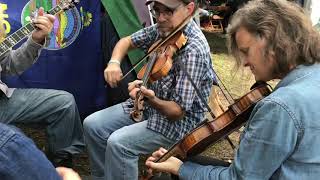



Yes, we did have a recent discussion that included a lot about seconding the melody being played by the lead fiddler. It was very informative (IMO), and worth reading through it again (I did). Found here: https://www.fiddlehangout.com/topic/60218
But the reason for this is not to rehash the subject (but there's room for it - if you have comments - please do), but to say - I spent the last weekend at "Breaking Up Winter" in Lebanon, TN. Trisha Spencer and Howard Rains were there putting on workshops, lectures, and a concert (along with others). One of the workshops was offered by Trisha. The focus was on seconding and how she teaches it. Very interesting. It kind of echoed a lot of what Dan Gellert had said in the attached post. Some of it here:
quote:
Originally posted by Dan Gellert
Hey. Thank you, Tony! I ought to check FHO more often.
I started playing second by sawing the chord changes on the bass strings, based on Cajun style, and a few other sources.. I'm remembering some recordings of John Summers accompanied by a fiddler whose name I forget. I think Frank George also played second to Summers on the recordings they did together.
Anyway, whatever I can do as far as seconding or harmony grows directly out of that. From 2-note partial chords I got to working in various rhythmic ways of arpeggiating around the notes in each chord, often winding up doing an outline of guitar bass-chord backup (or the bass side of an accordion). Using the same bass runs and/or passing riffs I'd use on a guitar or banjo added another bagful of harmonic possibilities.
Making a 2nd part for a particular tune, I'm listening for where the phrasing and the melody can handle my throwing in a big chord, or a beat or two of detailed harmony. I choose one, and figure out what I want to do with just that one riff, sometimes by slowing it way down and singing the lead and playing along. On a lot of tunes, one or two specific riffs or notes is enough, and the rest of the time I'm keeping time noodling on the chord notes, trying not to crowd the lead too much, especially if I'm just playing a straight duet with another fiddle (no other accompaniment).
Hope that makes some sense.
******************
And at the tail end of the thread he also mentioned a book being offered by Trish that I thought would be worth repeating:
Originally posted by Dan Gellert
Just realized... Someone mentioned Tricia Spencer, but no one brought up her unique and excellent book, a significant portion of which is about playing second!
https://www.spencerandrains.com/product-page/the-fiddle-garden
I bought the book while we were at the workshop. Good information. It's going to be a little harder for me - because the instructions / exercises are written for folks playing in standard. The principles are still the same - and has inspired me to continue in this direction. Heck. I might even decide to use this as an excuse to begin a "standard" journey, just for seconding (for now).  But a lot of what she said - caused me to remember what Dan had mentioned (above) and made my light bulb get a little brighter.
Thanks again to Dan for sharing and a shout to Trisha for a great workshop!
Edited by - tonyelder on 03/09/2026 14:51:04

I recently posted this video I came across of Tricia and Howard, along with Kellie Allen and Pete Peterson playing in 2018. She does some seconding, especially in the second half of the video.

quote:
Originally posted by DougDI recently posted this video I came across of Tricia and Howard, along with Kellie Allen and Pete Peterson playing in 2018. She does some seconding, especially in the second half of the video.
Yes. Porter's Reel is a favorite of mine, and they did play it over the weekend. ...and now that I have the memory of what she taught - I see it in "action" in the video - her "Grandma's Cheats" / using her three basic - 2 finger chord patterns: "2-3", "3-1", and the "1-2". Other patterns can be added.
One of the big takeaways from her workshop addressed my previous question about "what do you do - or want to do?" when the version of a tune being played is different than what you know. She was pointing to when you aren't familiar with the tune being played. Her suggestion was to use her "Grandma's Cheats". She says that the best thing to do is not focus so much on the melody - but rather on the chord progression and the rhythm. Capture the rhythm first with the root chord - until you understand the progression. Then move the 2 finger patterns to sync up with the chord changes, and then start to add different noting patterns that are found in the other chords. 9 times out of ten - it will work, as long as you are in sync with the rhythm pattern and using the right "chord". ****Pretty much what I understood Dan was suggesting, but it didn't sink in at first. I have a better understanding now. I think I kind of intuitively knew this, but I needed to read it / hear it for things to click in my head. (kind of slow sometimes) ...next step - do it.
That's my starting place. But I need to find all my 2 finger patterns for cross tuning.  But I already know most of them (if not all). They are all double stops - that I've probably been using all along. I just never thought of them this way. So, a little time spent adjusting the way I think - to include them this way in my thinking too.
I can use this "formula" with the recordings I learned the tunes from - and be better prepared to "second" when I feel confident with it. Ahhhh.... I will prepare folks if I intend to try - prepare them for something that might throw them off - instead of just springing it on them unaware.  How to make friends...
Edited by - tonyelder on 03/09/2026 16:07:12
her "Grandma's Cheats" / using her three basic - 2 finger chord patterns: "2-3", "3-1", and the "1-2". Other patterns can be added.
Bizarre how this is labeled "cheating"; double stops are the basis of all harmonization; accompanying, backing, seconding, twining and improvising.
A double stop consists of two notes from the same triad; the upper two or the lower two. There are at least three different double stop patterns of the same chord on every pair of strings in first position, and the stops in between can act a passing chords. A double stop can also be considered as a chord extension, and each note of a DS will function as a target note.
Yeah, I know it's not meant in the true sense of the word, it's suggested they're used when the melody is not known, thus one can still play by accompanying with double stops, 'cheat'. I just seized the opportunity to present my ideas on the double stop.
Terms of Use | Privacy Policy | Privacy Consent (EU/GDPR Only)
Copyright 2026 Fiddle Hangout. All Rights Reserved.