



There is a tile floor throughout my whole appartement, I already have rubber with vinyl in the living room for the dog's indoor play room and a large rug.
I still needed a solution for my practice room, which is the bedroom. So I just ordered 24 tiles of +- 12 inches each for the two walls that are closest to the neighbouring appartements.
The hope is it will absorb the sound that is being reflected by the tile floor so the neighbours will hear less and it's also good for my own ears I guess.
The cost was below 65 euro and the tiles have prefab glue so they can be adjusted as a sticker.

Heavy curtains are a good solution. They dampen some of the sound when it hits them then they absorb some of the sound as it travels through. When the sound bounces off the wall behind, they do the same on the way back.

I feel my neighbors pain considering my new drum set! Good on ya for making an attempt to dampen it. Sounds like it should work.
Also, they make some pretty cool artistic wall hangings. Pretty easy DIY projects out there too.
Tiles should help, if your lease allows sticking things to the walls. As others have said, draperies or wall hanging can also be a good solution. If the floor in the room is still just tile a rug can help stop the reflections at the source - a pad underneath is even better. Most bedrooms have a lot of soft surfaces - bedding, pillows, etc. The more the better. If there's other furniture, placing it to minimize parallel surfaces can also reduce reflections. Good luck.
Edited by - DougD on 10/21/2025 06:43:02
quote:
Originally posted by ErockinI feel my neighbors pain considering my new drum set! Good on ya for making an attempt to dampen it. Sounds like it should work.
Also, they make some pretty cool artistic wall hangings. Pretty easy DIY projects out there too.
Yes ! I first found this beautiful artwork of a lonely boat on the water. But then I saw how much more I got for only 10 euro extra. It was tempting. I read you don't necessary need to cover all of the walls, 1/4th or 1/3rd of the floor surface could be enough.
Packing blankets from UHaul, they work great .. you can also buy them, very inexpensive
Play Happy
Swing
There are a number of ways to dampen sound. In basic terms, soft surfaces absorb well. Throw rugs, stuffed furniture, and draperies all soak up sound fairly well. You can buy panels with rock wool, which is a good absorber, and install them along walls or ceilings (if you can attach them to those surfaces).
I’ve seen some people hang rugs on walls or mount large panels of soft packing-style foam as absorbers.
Anja, the science of acoustics is complex, and you can't just go by some generalized fractions. You have two problems to consider here. One is to deaden the room surfaces enough that the sound decays through absorption rather than builds up or sustains through reflections. Carpets, soft furniture, wall coverings and curtains over the windows can all help with this. The pros have various ways to analyze the acoustics of a space, but just a handclap can give you an idea. You can hear how long it takes for the sound to decay, and what the reverberation sounds like. If you hear a "ringing" sound you need to apply more treatment to reduce "standing waves" (when the sound reflects back and forth between "live" parallel surfaces) or change the shape of the space, not an option here. Ideally you should end up with a room that's pleasant to play in.
The second goal is to try to reduce the transmission of sound through the wall to your neighbors. Recording studios in large, noisy cities go to great lengths to achieve this isolation, including double walls with no shared structural members, air locked double doors, etc. They are mostly concerned with keeping noise out, and sometimes the floors of studios are mounted on springs to reduce vibration from underground trains. Draperies, tiles and blankets can all help with this. In your case you will have to see this treatment constantly, so even though moving blankets might help they're not much to look at. Standard acoustic tile might make you think you're in an office instead of your bedroom. I like the "acoustic painting" idea, but even here a representational piece might get old over time - maybe something a little more abstract might stay fresher. Depends on what you like.
Good luck. I'm sure you will be able to improve things fairly easily.
I have found burlap fabric works well, and is fairly inexpensive.
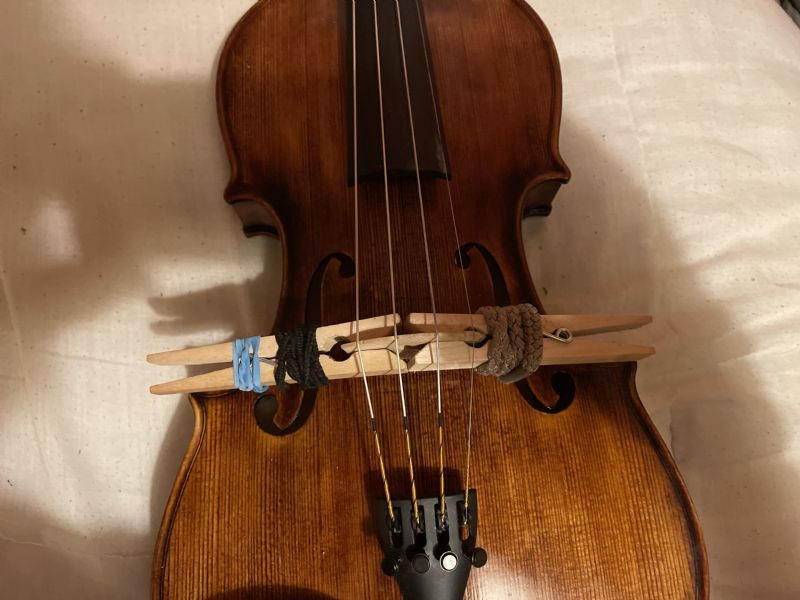
My current method of sound absorption in the bedroom.
Yes, room acoustics is a field where you can go as deep as you like and there will still be some mystery. With all the technological advances of the modern age, it’s still a matter of chance whether a hall designed specifically for music will actually work well.
That being said, one can still generally make improvements with some time and effort, especially in a small space. Absorption is fairly straightforward—soft surfaces will absorb. Reflection can get more complicated.
Recording studios tend to dampen sound to an extreme to eliminate all sound reflection and provide a recording that is as flat as possible so that all the ambience can be added in production. It’s easier for sound technicians to add reverb than to take it away.
For listening, spaces like that aren’t particularly pleasant, as they are so dead that you lose a lot of the sound quality. A good room is live enough for there to be good clarity in the performance for the instrumentation and reverberant enough for it to wash over you. You can experiment by adding hard or soft surfaces in various places to see what gives the results you like best.
If you want to dive into it further, Anders Buen has shared a lot of information about room acoustics on Maestronet in the past. His research is highly regarded and he has done a lot to make it accessible to the public. By using Audacity and popping a balloon in a room in his style you can get a basic reading that you can plot and analyze. A hand clap could be used, although I think the point of using the balloon was to make the impulse more consistent.
For keeping the noise down for the neighbors, absorption is the guiding principle.
Soundproofing is different than acoustic treatment. There are lot's of YT videos that can explain differences. There is a lot of "buyer beware" involved with solutions or products see on internet.
Acoustic treatment is to make the room sound better. Besides absorption, reducing reflection; often using diffusion. The goal isn't necessarily to deaden the room, make it quieter, or eliminate reverberation; but deal with room mode issues, (especially problematic in parallel surfaces and corners), and create problem frequency hot spot or build up (or dead spots); the goal is more about make it more even or flat response across all frequencies. Room mode includes where you stand in a room can play a role, both as sound source, as well as ears and perception of the room acoustics. Diffusion works to break up reflections to more random angles. Acoustic treatments can give illusion of sound proofing.
But it seems like the issue is more soundproofing (neighbors)? Soundproofing is reducing the transmission through walls, ceiling/floor, doors, windows, and air gaps; which can be more complex, and costly. A lot of acoustic treatment materials, commercial or things like rugs, carpet, foam, curtains are really too thin to have much effect; do little except for the very high frequencies. The lower you go in frequency the more soundproof material you need to achieve equivalent loss in dB. The issue probably isn't 10K and above, but probably 5K and below (maybe around 200 Hz for fiddle). Distance from the source (to say shared wall) is an aspect to consider, as sound energy or dB reduces with distance. If can move to adjacent room, and tightly close door, besides distance can create a room within a room idea. Room within a room can be a solution, essentially making a second wall, possibly movable, but takes up a lot of space.
For many apartment dwellers, it can be problematic; and the easier pragmatic solution might be as martyjoe shows... simply a mute. The make commercial ones that are inexpensive, from rubber, plastic or heavy metal... work great.
The other solution I found useful... is simply talk to neighbors and work with them. Perhaps not as much issue as think, or simply working out time, schedule; maybe give and take.
Edited by - alaskafiddler on 10/23/2025 17:35:36
Terms of Use | Privacy Policy | Privacy Consent (EU/GDPR Only)
Copyright 2026 Fiddle Hangout. All Rights Reserved.