


I am trying to find out who installed the frets on one of my fiddles years ago. Does anyone know of someone who installs frets on a fiddle? I don't mean the stick on fret tape with fishing line as a fret, I mean real metal frets cut into the wood. I think I sent my fiddle to california to have the frets installed but I don't know how to contact the guy who did it.

I haven’t done it myself, but a local teacher had some rosewood frets installed on the violin he used for teaching. They were not normal frets in that they were made of wood and cut flush to the fingerboard, so that they were essentially permanent finger tapes for students to use as reference. I don’t know who installed them. The violin recently showed up at a shop where I do contracting work. The salesman said he was considering staining the frets so they wouldn’t be visible anymore because they made the instrument harder to sell.
I recall seeing some old German novelty violins with frets.
Why do you want frets on your fingerboard? Aesthetics? To use like finger tapes? To aim for a different type of sound?

Not a terribly new idea.
He makes both functionally fretted and non-functional fretted necks.
Edited by - farmerjones on 07/23/2025 14:01:44
Well, somebody's doing it:
They say they'll make a custom fretted fingerboard to fit your fiddle.
I dislike the idea, myself. At best, frets will give you accurate 12-tone equal temperament, which means every interval is at least a little out of tune, and some are more than a little off. They make it easy to play almost-but-not-quite in tune, but impossible to play genuinely in tune. IMO, if you can't hear the difference between a just third and a tempered third, you need to practice listening, and if you still can't (or if you do, but it doesn't matter to you), just switch to the mandolin-- the dissonance is much less obvious on a plucked string than on a bowed one.
While I mostly agree with Dan's points, I think fretless works for the type of fiddling I want to play, intonation 12TET is one aspect but not only one. That said fretted is perhaps just about different idea of playing. (similar to comparing standard fretted guitar/banjo to fretless, just different style). Nyckelharpa is another bowed fixed pitch idea.
It's has become a bit more popular in the realm of electric violin world (esp 5 and 6 string). It works for the type of music/style/sound they are looking to play (not really traditional fiddle); perhaps idea of more like bowed electric guitar (inc. bends); and might use a lot of FX, (distortion/overdrive, delay, chorus, reverb) that would mask intonation.
But those retail sites and makers that cater to that EV world, might be resource for someone who could do a conversion. Guitar/banjo world you can get pre-slotted fingerboards, have work done locally; but my guess is that doesn't exist for violin, so would have to send fiddle to them.
Edited by - alaskafiddler on 07/23/2025 16:15:16
Forgot to mention something folks often forget to consider, is frets will add weight on the neck end. Which I factor in, lighter and better balance weight is just more comfortable over duration of playing.
To be sure, it takes more care and practice to reliably hit the note/pitch you want, but I feel liberated by the lack of frets. It makes the instrument more like that of an actual human voice.
I knew a professional guitarist who suddenly became a good fiddler. I asked him what happened, and he had installed wooden frets on the fiddle. When I started, I bought a detachable fingerboard with frets. It helps getting the fingers where they belong. But eventually a person has to play without frets. An instrument without frets can produce more different sounds than a fretted instrument. You have to train you ear as well as your fingers. So when practicing scales, I play along with recorded scales.
Wouldn’t frets remove the ability to do “slides’ …
which are part of the style of fiddling in many styles?
But then again, guitar players manage slides...I'll have to go test how to slide on my guitar!!
Frets might get rid of ability to do vibrato, at least?
Edited by - NCnotes on 07/30/2025 06:58:42
quote:
Originally posted by NCnotesWouldn’t frets remove the ability to do “slides’ …
which are part of the style of fiddling in many styles?But then again, guitar players manage slides...I'll have to go test how to slide on my guitar!!
Frets might get rid of ability to do vibrato, at least?
The fella that is in charge of the weekly session in Mullingar plays a fiddle that has frets all the way up the fingerboard. He has one fingertip missing from the first nuckel. I don't think he was ever any good to start with (on anything) anyway. When I look at it I wonder how the intonation works because the formulae for spacing the frets have to take in string tension to be correct. It all looks just wrong to me!
Right! Frets = no traditional vibrato. You'd need to stretch the strings side to side like guitar players do.
Played with a pedal steel player decades ago who had frets put on a fiddle. . But that fiddle sounded really BAD with frets.
quote:
Originally posted by NCnotesWouldn’t frets remove the ability to do “slides’ …
which are part of the style of fiddling in many styles?But then again, guitar players manage slides...I'll have to go test how to slide on my guitar!!
Frets might get rid of ability to do vibrato, at least?
Slides on a guitar or fretted banjo are not portamento slides; as they are really just able to go from one half step to the next... but can be done quickly, so it creates effect. With bowing, hypothetically might still be able to slide, as the string doesn't need to contact the fret to sound, so could get the in-between.
Vibrato - as mentioned can use finger wiggle vibrato; (frets or not) mostly just using finger to change tension, from just up/down axis, or with like guitar from lateral bending. Guitar vibrato only produces sharper side, not the wavering between flat/center/sharp. With that is narrower (as wider might give overall sound seem sharp). I do notice that some fiddlers use finger vibrato, perhaps due to coming from guitar?
Edited by - alaskafiddler on 07/31/2025 01:26:38
quote:
Originally posted by martyjoe
When I look at it I wonder how the intonation works because the formulae for spacing the frets have to take in string tension to be correct. It all looks just wrong to me!
Like all fretted instruments; it generally does; fret spacing and set up needs to take in account for tension and string height (affecting tension and angle/length). There are formulas and even online calculators that take these into account. Fret spacing just uses typical middle range string gauge/tension, not knowing if player wants light, med, or heavy strings... and then use set up adjustments to bridge, or possibly neck to try to compensate, to get reasonably accurate close. If change to different string gauge/tension, need to adjust the set up. It will probably never be perfectly correct all up and down on every string.
Viloin family instruments string height is more of a factor; extra height requirement and variability.
Edited by - alaskafiddler on 07/31/2025 02:06:58
quote:
Originally posted by alaskafiddlerquote:
Originally posted by martyjoe
When I look at it I wonder how the intonation works because the formulae for spacing the frets have to take in string tension to be correct. It all looks just wrong to me!Like all fretted instruments; it generally does; fret spacing and set up needs to take in account for tension and string height (affecting tension and angle/length). There are formulas and even online calculators that take these into account. Fret spacing just uses typical middle range string gauge/tension, not knowing if player wants light, med, or heavy strings... and then use set up adjustments to bridge, or possibly neck to try to compensate, to get reasonably accurate close. If change to different string gauge/tension, need to adjust the set up. It will probably never be perfectly correct all up and down on every string.
Viloin family instruments string height is more of a factor; extra height requirement and variability.
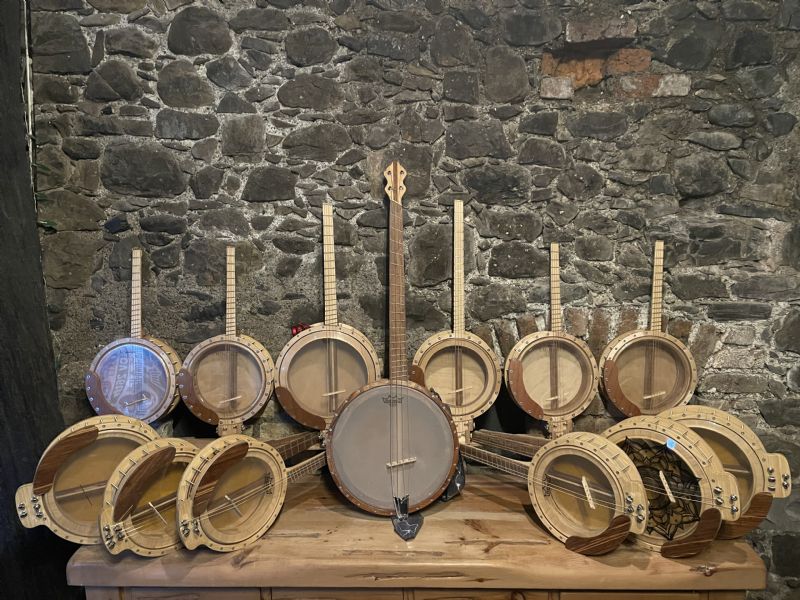
Exactly! And as you've pointed out the violin family factor is just adding more complexity to go further "wrong ". Whenever I make a banjo I have to make all those considerations plus I have to make two calculations.
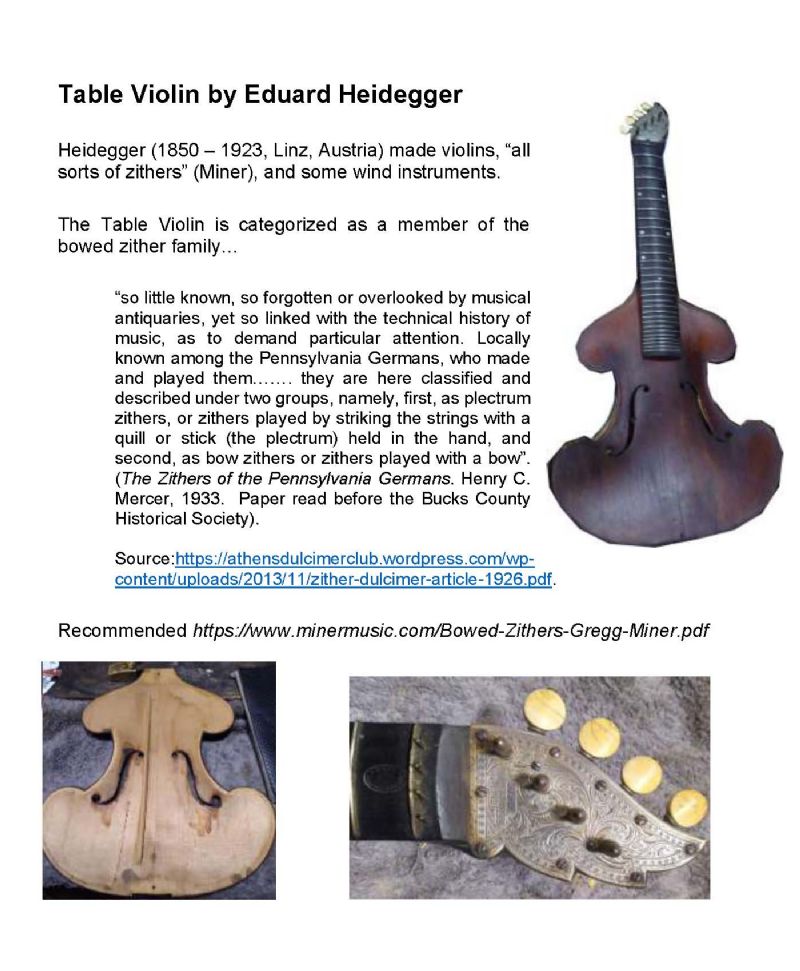
I had a weak moment and bought a basket-case, fretted "Table Violin" on eBay. I've shown it to a couple of people who are familiar with table violins, one of whom had actually played one. Eventually I'll finish repairing this one.
Whoa…interesting violin!
I am having no luck trying to get a slide sound on my guitar (nylon acoustic classical)! So I assume it wouldn’t work well on a fretted fiddle either?
Yep vibrato is possible but it sure takes a lot of effort, phew. Like 1000x effort for me. But I am no power guitar player!
So I think you lose some stuff going to frets, but you also gain the easy intonation. But if you like to “shade” your notes with little slides or use “in-between notes” (like that C between sharp and natural, in Irish) … then you’re outta luck with a fretted fiddle…
There’s also this little trick I use to play with out-of-tune instruments… If they are going sharp, like flutes tend to do, I’ll ( somewhat subconsciously) shift hand a tad high so we’re still mostly in tune. Outta luck there too, with frets…
Not to bash fretted fiddles! but there will be some limitations…
quote:
Originally posted by NCnotes
Not to bash fretted fiddles! but there will be some limitations…
Go ahead and bash them. They are horrible.
Hahaha!
I learned never to bash anything….good musicians can get amazing music out of anything…you never know, what someone will take a liking to and latch onto as their instrument!
You don't need a bow either. just get a hurdy gurdy. Then if you don't get on with that a programmable electric organ of some description , Then if you don't get on with that an mp3 player or something....etc. Lets face it, it ain't a fiddle if it's got frets.
Whenever I look at one of those Fretted fiddles, The instrument maker in me makes me think that they are more likely to ruin intonation.
I do slides, bends, etc. with frets on guitars and banjos, so, I don't think that would be an issue itself...but frets, as discussed above, turn it into an equal temperament instrument, which in my view, ruins the nature of the fiddle/violin.
I don't understand why anybody would do that. I don't even understand the fret tapes...maybe for extreme beginners, maybe they might give you an idea where you should be going, but to me, it seems to really take advantage of the tonalities in an instrument without fixed tuning, you need to just find where you are going without having to see it visually. Besides, I never understood how a person can actually see the neck of the fiddle while playing it...I feel like I'd break my own neck trying that...lol...so I'm confused in many ways about all of that.
I've told this before, but a long time ago I'd read about a great violinist...maybe it was Itzak Perlman or somebody great like that...he had a master class where he would pull students' violins slightly off pitch before they were to play before their fellow students. Think about why he would do that. That idea means fretless should be fretless, doesn't it?
Of course banjos became fretted, and now we have a choice...fretless or fretted. so I guess one could argue the same to be said for fiddles/violins. But I would never want anything to do with one, myself. I just don't see fiddle that way. Of course I don't think I'd really like playing a fretless banjo that much either, so, I guess my banjo concept is strapped down by frets. So why couldn't a fiddler be the same about a fiddle?
But I'm also thinking to measure out the frets you couldn't have the pure tones of the perfect fifths or fourths if you cross-tune...anyway...you would have to tune your strings "off" a little for the frets to work out as they go up the neck. I can't imagine having that on my fiddle.
One reason Calico/Blk Mt tuning always sounds funny to me is that third in there with the perfect intervals...it has an "off" sound to me at least, although I have used it and like it for certain things...but it doesn't taste quite right to me. Not my favorite, although I realize some things have the drones working out better there. Still, my point...they are fretless for good reason. But so were banjos once...I guess if people wanna change fiddles like that, they have every right to, we do live in a free country...or used to anyway.
It's amazing to me how the frets are arranged on dulcimers...they are sorta droney, perfect-interval instruments but with frets...a foot in both worlds? But the frets do fix a person to a particular mode ONLY...you try playing some tunes and it just won't work. Of course now days the dulcimers have "cheater frets" so you can cheat...and once again, to my ear, make an "off taste" in the dulcimers. I'm not a fan...my dulcimer doesn't have the half frets...I wish I had time to play the doggone thing. I wish I had time to play any of my poor ol' instruments now...busy taking care of hubby now. Takes all my time and energy, and keeps both his and my own personal nature locked up like frets jailing our heart and soul. But anyway, just thoughts on frets here. I guess a fretless guitar might be something like a lute??? Except they had movable frets...which makes me think they must've been more like the real dulcimers before the half frets started showing up...both they and dulcimers could be transitional fossils in the music world.
Yah, I think putting frets on a fiddle takes away a big part of the fiddle’s charm, and also the enjoyment of playing. I don’t think it would be nearly as much fun to play a fretted fiddle.
I’m willing to accept the occasional intonation mistakes in exchange for the ability to shape the notes exactly the way I want them to sound at a particular moment. The next time I play that tune it will probably be a little different.
The dulcimer is not restricted to one mode. As I understand it needs re-tunning if the open drones are still required, then the key note of the new mode would begin on the first fret.
Some solid body electric violins have frets, specially if they have 5 or more strings, but, apparently these frets have such a low profile they can hardly be felt.
Recently classical guitars have been made without frets, but the conventional technique is defunct. They can be played like an oud I suppose.
The root of the mode you tune to can go to different frets on dulcimer. To play dulcimer, you gotta know yet modes...lol...for sure.
Terms of Use | Privacy Policy | Privacy Consent (EU/GDPR Only)
Copyright 2026 Fiddle Hangout. All Rights Reserved.