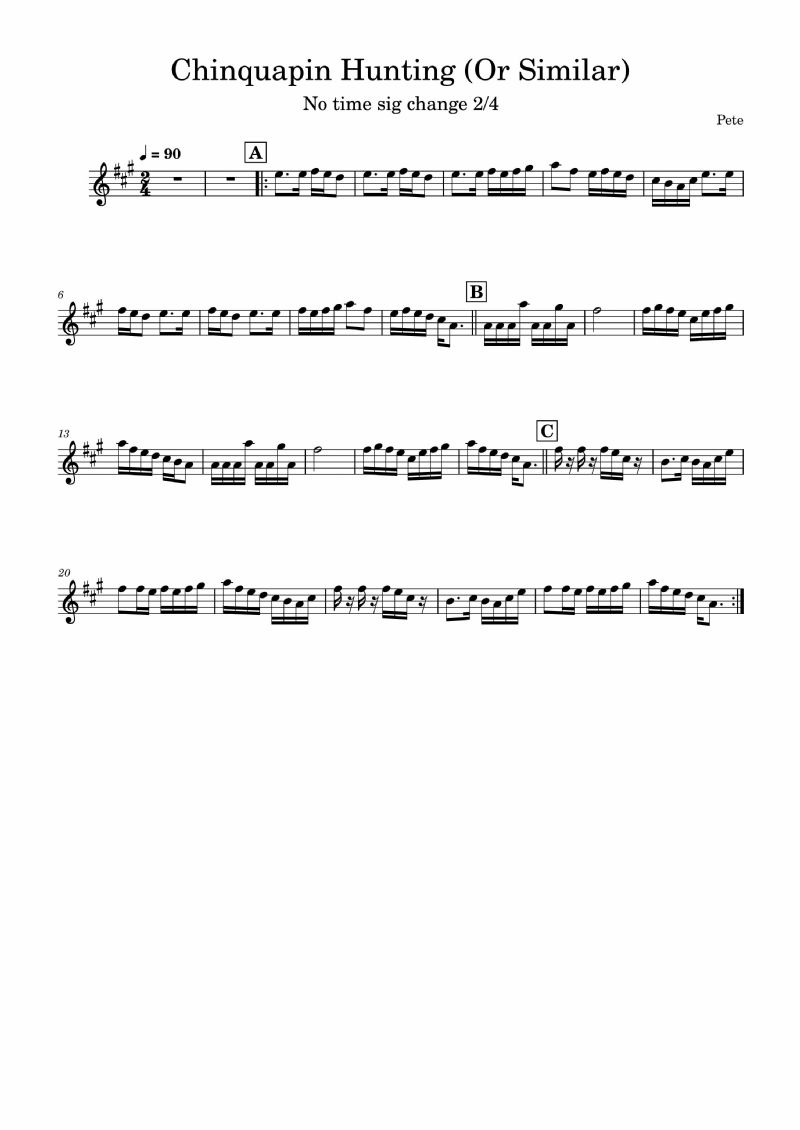



quote:
Originally posted by pete_fiddlei think you could also write that 1st part out as 9 bars of 2/4 (repeated), with no time signature change. The rest of the tune is square. Maybe the simplest way?
I very respectfully disagree. But then - all of this depends on the version being referenced. I learned from a recording of an "unknown group" (I don't have the name of the group in the mp3 file). But the arrangement is the same as what Bruce Molsky played on the YouTube recording - which I think is captured in the notated score I posted.
https://www.youtube.com/watch?v=TYS7xyNW8Mc
I learned / play this version - slower - but the same variation / version. Youtube has a feature that allows you to slow it down. Slow the recording to 1/2 speed. and listen to see if you hear a rest in that last phrase. I hear the "short measure" going right into the next phrase (different time signature) - no pause (rest). To me, if counted as 4 beats, it would be counted off as = 1234, 1234 1234 1234, 12 / 1234,1234, 1234, 1234, 12. But the count that George suggested agrees with the written notated version:
"I would think about notating first 3 measures in 2/4, then one measure of 3/4. To me, maintains idea of steady beat" - or 12,12,12,123
...both would correctly capture the beat of the recording (to my ears) - all equal in duration but more (or less) beats in the last measure of the A phrase.
If correct - that is a change in signature / crooked / not square. There is no rest making the measure / bar the same time duration as the others. The beginning of the next measure is right on the heals of the last note of the first "round", and the B part starts the same way - right on the heals of the last note in the last phrase (2nd round). Other versions may not play it that way - but this version does (imo). And that is the way I learned it / play it. And I think that is the answer to the OP. But - maybe I'm wrong. I'm sure there are versions played that include the rest (or notes) to make it square, but the charm of this tune (imo) is playing it crooked.
Edited by - tonyelder on 06/15/2025 17:17:00


OK. I see what you are saying, and I agree. Written out like that, the signature stays with 2/2, no changes. It does "screw" with the phrasing a bit, by having the opening notes of the A part as the last notes of the 1st round - but it does make it things work out on paper. The format takes on a look more like A/B/C, instead of AA/BB/CC - but none of that changes the way it gets played.
But - let me ask another question:
9 bars of A leaves a total of 25 bars for the tune. Is that square?
Definitely not, just simpler to notate and read for me. As i said 32 bars, and no time sig change is square for me. The extra bar of the A part of Chinkapin. seems to start me off on the other foot, and is more straight ahead so to speak for me. But then resolves back rhythmically to square on the B & C parts. Anyways thanks for giving it a look
Edited by - pete_fiddle on 06/16/2025 09:55:12
That puts the down beat, and start of the second A in the middle of a bar (on count 2)?
When I just listen/experience most music, to me, has a sense of structure, and sense of underlying meter is part of that, that helps form rest; of phrasing, the start and end of musical thoughts; and sense of rhythm. With that, some might contain feel of Irregular meter or mixed meter.
I think if writing as notation, can be useful to help convey that sense of structure, phrase, parts, meter, beat. Bar lines should reflect that, describe perceived sense of underlying meter to structure. Not about simply counting, make the math fit, or eventually add up, on paper.
Perhaps others don't perceive music that way? Like those who wrote with no bar lines at all... I guess reflecting no sense of meter, beat or phrasing? More like the midi, it's unimportant to output, doesn't really pay any attention to structure, phrases, beat, meter... just linear sequence of quarter/eighth notes?
Edited by - alaskafiddler on 06/16/2025 11:45:38
I mostly don't think about or worry if square or not... except when playing for dances, esp contra.. as the dance is phrased that way.
like i said, it doesnt just make the maths fit it "starts me off on the other foot" if you know what i mean.
i think the beauty is in letting the listener decide where the emphasis should be. if they coincide with your own interpretation, all well and good. If they don't it's a revelation to you and a nice point of tension/interest to them. i find when trying to write down the notation it is hard to discipline myself not to start notating variations and ornaments etc. The same as if i was actually playing the tune.
Terms of Use | Privacy Policy | Privacy Consent (EU/GDPR Only)
Copyright 2026 Fiddle Hangout. All Rights Reserved.