


Banjo Hangout Logo
Banjo Hangout Logo

Premier Sponsors


Bowing

Join This Group

Bowing patterns, techniques & approaches. How do you learn to bow in a particular style? What works for you, what doesn't?

94 Members, Created 3/9/2011 -

Administrators: dsreiner (owner)


< Back to Home

Bowing patterns

From dsreiner on 3/9/2011 9:58:20 AM

While each fiddler gradually develops his or her own approach to bowing, I find it's very helpful to understand and learn the common bowing patterns in the traditional styles I play. In my view, bowing patterns include not just sequences of downbows and upbows, but also rhythmic groupings and slurs, accents and pulses, chops and anticipations, bow rocking and string crossings.

Names for basic patterns include saw stroke, Nashville shuffle, middle shuffle, Tommy's shuffle, etc.  Learning these patterns from another fiddler is preferable to using transcriptions, which really can't capture the accents and nuances.

Of course, I recognize that some fiddlers don't think in terms of patterns, and prefer to work toward the sound of a style (or a specific fiddler) without conscious thought about the bowing. Different strokes...

What are your thoughts about bowing patterns, techniques, and approaches?  How do you learn to bow in a particular style?  What works for you and what doesn't?

Dave

P.S. With my son Andy, I'm in the process of writing a bowing book for my music publisher, so these issues are very much on my mind :-).

6 Comments

dsreiner says:
3/9/2011 10:04:28 AM

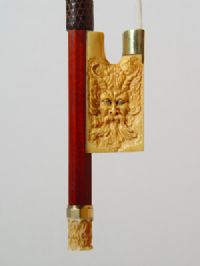
The bow photo for this group is from the gifted hands of Henryk Kaston (henrykkaston.net ).

Dick Hauser says:
3/13/2011 8:54:27 AM

I learn best when I have notation and visuallyl recorded instruction. I am not a "watch me and follow my fingers" guy. I prefer listening to the music and studying the notation for a while, then listening to the instructor. That way I have a list of questions that I want answered.
Each tool has strengths/weaknesses, so using notation and audio/visual information provide the work best for me. I think instructionals should provide more information regarding where/when specific techniques work best.

fiddlepogo says:
3/23/2011 1:43:56 PM

To me, a shuffle or pattern is an entity unto itself that needs to be practiced in isolation on a suitable easy tune or in an exercise.
I keep patterns on the back burner this way, sometimes for years... even DECADES! Eventually the pattern gets smooth enough and along comes a phrase that's just begging for that pattern, and I "accidentally" use it, and pretty soon, I'm using it all over the place.
When I started, I used "anywhichway" bowing, still do when learning a tune, reading notation, waltzes, and slow airs.
Then I learned Nashville Shuffle,
Then I learned Georgia Shuffle.
I never integrated the two, although I've since learned there is a way to do so.
Then I learn what I call Smoothshuffle (3-3-1-1) while attempting to imitate one of Tommy Jarrell's bowings.
By this time I was pretty much a confirmed downbower.
About this time, Tom Sauber showing me Syncoshuffle (1-2-1-2-1-1) but that was to stay on the backburner till about 3 years ago!!! And I identified Offset Nashville from a festival recording (1-2-1-1-2-1), but that was to stay on the backburner till about a year and a half ago. Then I got musically isolated in a small towns where I didn't know any other fiddlers. I think Sawshuffle clicked during this time (1-1-1-3-1-1). Then I traded off the fiddle about 1990 because I had stopped playing it (my only jamming partner had died, and it made me sad to play instead of glad) and didn't start playing again until 2005. When I restarted, I played nearly everything with Sawshuffle and Smoothshuffle, then I added Syncoshuffle and Offset Nashville... also one I don't have a name for that I remember Byron Berline using.
I'm dabbling with 1-1-1-2-2-1 and 1-2-2-1-1-1 that Mike Fontenot mentioned in a recent post. Haven't named them yet!!!
When fiddlers from other styles hear me play, usually the first thing they comment on is the bowing rhythms... they often find them fascinating.

Recently I renewed my interest in Irish Trad. It's funny, I don't even think about bowing, except occasionally I do notice that I am using some pattern or another, but I'm drawing on them unconsciously, and using them only for phrasing... they aren't nearly as overt as they are when I play Old Time.
Just today, I was playing Ships Are Sailing, and I noticed that I was using Nashville Shuffle in the B part! But it doesn't slap you in the face, because the long strokes are the place I'm sticking the left hand ornament, and the focus is on that, not the bowing.
In fact, I'm beginning to think that that is a major function of bowing patterns in Irish Trad fiddling- it's a way of putting a slur in a place that allows the left hand to go to work on ornamenting it, but without the phrasing getting screwed up.
And the phrasing is important, because that's how you get the "lift".
In Old Time, the slurs are usually used to draw attention to accented single strokes.
One key aspect of shuffle patterns is that they are somewhat related in families-
Nashville Shuffle, Syncoshuffle, and Offset Nashville are all related, and Smoothshuffle, Unshuffle, Sawshuffle, and Georgia Shuffle are very close to each other as well.

While I recognize the possibility of notating shuffles as part of the notation for a tune, I've never learned a shuffle pattern that way.
I tend to use them in an intuitive, seat-of-the-pants way.

Oh yeah, when I'm playing backup on fiddle, sometimes, if the volume of the instrumentalist permits, I will shuffle the backup instead of chopping it. It's also a useful thing in a jam that's starting to drift rhythmically due to too many rhythmically challenged players joining in!

Moonpie50 says:
4/13/2011 11:57:35 PM

I am a new fiddler and really trying to make sense out of all the different bow patterns. I recently purchased a Mel bay DVD Super fiddling or something that....the fiddler was a guy by the name of Ed Marsh. I learned a few things from this dvd. But have a long ways to go but always up to learn new things.

vibratingstring says:
6/15/2011 9:44:37 AM

Dave,

I am new to fiddling and the bowing patterns are the thing that is the biggest mystery to me. When I watch or listen to Molsky play, and many others, the patterns are interesting and complex. I attended a weekend of workshops recently where Debbie Rifkin held a bowing workshop. I found the bowing pattern exercises to be very illuminating. I think a book on bowing patterns (starting at the beginning, of course, for us beginners) would be a great addition to the learning material out there. I told this to Debbie as well.

I hope that there is a bowing book out there soon, and I also hope that it is accessible to beginners like myself. Good luck. Let me know if you need the perspective of a novice. :)

Larry Toto

dsreiner says:
6/15/2011 11:00:50 AM

Hi Larry-

Thanks for your thoughts! Our book and DVD will definitely be accessible to beginners.

Best,
Dave


Post a Comment

You must be logged in and a member of this group to post a comment.

Terms of Use | Privacy Policy | Privacy Consent (EU/GDPR Only)

Copyright 2026 Fiddle Hangout. All Rights Reserved.


Hangout Network Help

View All Topics  |  View Categories

0.4921875