
DVD-quality lessons (including tabs/sheet music) available for immediate viewing on any device.
Take your playing to the next level with the help of a local or online fiddle teacher.
Monthly newsletter includes free lessons, favorite member content, fiddle news and more.
Premier Sponsors



|
Please note this is an archived topic, so it is locked and unable to be replied to. You may, however, start a new topic and refer to this topic with a link: http://www.fiddlehangout.com/archive/59930
pete_fiddle - Posted - 04/23/2025: 15:14:37
It seems to me that half of the "Keys" on the cycle of 5ths Eb through to D are intuitive and, dare i say it mechanicle, fingering and bowing wise. And the other half of the cycle of 5ths A through to C#, are more expressive and interpretive/subjective. i'm Just starting to explore these keys. (E,B. F#, C#). They seem to have a Totally different Character on the fiddle to me. Anyone else find the same?
Here's AI's response to the same question:
"String Resonance and Open Strings: The open strings of the violin (G, D, A, E) play a huge role in the instrument's resonance and how different keys feel. Keys that heavily utilize open strings (like G, D, A, and to some extent E) tend to have a more immediate, ringing quality. The "intuitive" and "mechanical" feel you describe for Eb through D might be partly because they often involve more comfortable finger patterns that fall nicely around the open strings, and the bowing can feel more straightforward due to sympathetic vibrations.
Fingerboard Geography and Intervals: The keys A through C# often require more shifting and venturing into higher positions on the fingerboard. This inherently introduces more subtle intonation challenges and necessitates a more nuanced left-hand technique. The intervals within scales and arpeggios in these keys might also fall under the fingers in ways that encourage more expressive slides, vibrato, and subtle dynamic variations.
Bow Arm and String Resistance: As you move to higher positions, the string tension and the point of contact for the bow can subtly change. This can influence the tone and require a more refined bow arm to achieve the desired sound. The "expressive and interpretive/subjective" feel could stem from the need to actively shape the sound more in these higher registers.
Historical and Cultural Associations: While perhaps less tangible, certain keys have historical and cultural associations that might subconsciously influence how we perceive their character. For example, some composers have historically used certain keys to evoke specific emotions or moods. While this isn't inherent to the instrument itself, it can contribute to our subjective experience.
The "Feel" Under the Fingers: The physical act of playing in these different keys simply feels different. The distances between notes, the angles of your fingers, and the amount of pressure required can all contribute to a different tactile experience, which in turn can influence your musical interpretation".
MargaretTheFiddler - Posted - 04/23/2025: 16:02:28
Something must be in the air… today and yesterday I sat around messing with playing a reel in every ‘natural’ key (A, B, C, D, E, F, G). It definitely took on different characteristics in each key.
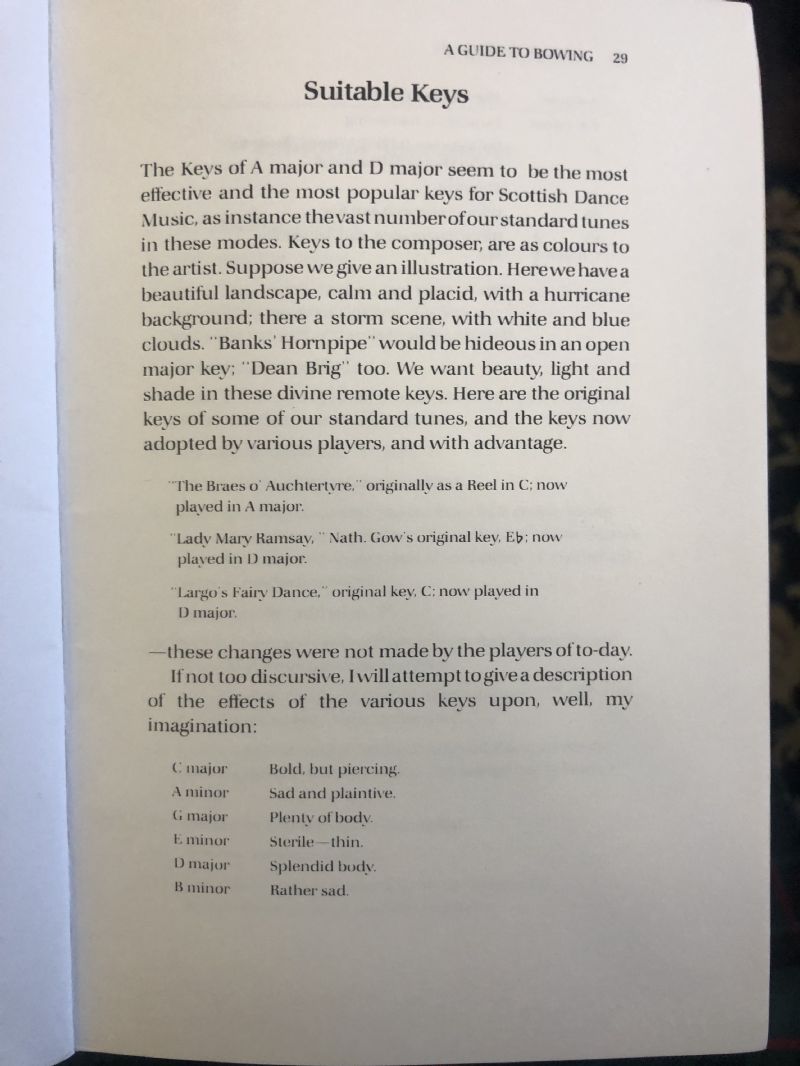
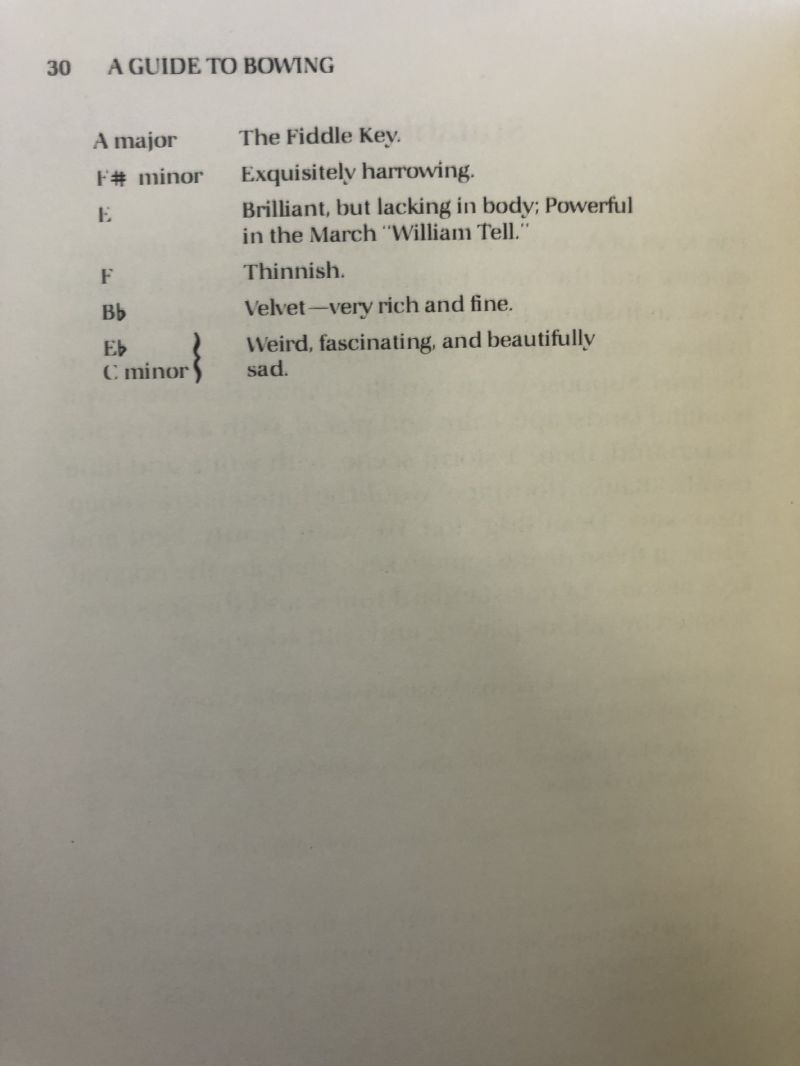
This is something people have wondered about for a while… this is what James S Skinner (the self-proclaimed Strathspey King) had to say on the matter.
buckhenry - Posted - 04/23/2025: 21:06:50
If a tune is played in the key of C major without any open strings using the 4th finger for those notes. Why is it more expressive to move the entire hand frame up a semi-tone and play the same fingered notes in C# major.
pete_fiddle - Posted - 04/24/2025: 00:26:21
quote:
Originally posted by buckhenryIf a tune is played in the key of C major without any open strings using the 4th finger for those notes. Why is it more expressive to move the entire hand frame up a semi-tone and play the same fingered notes in C# major.
Don't know but i'm tending to agree with the AI . The differences become more apparent to me, playing in the relative minor keys. i suppose there are no open notes to shift on, or for comparisons, which pulls me back into "the fiddle's" intonation and resonances. So i have to rely more on my own intonation which is subjective (to say the least).
In the case of the relative minors, especially harmonic and melodic, it seems to me that the "width" of the intervals is even more subjective and dependent upon style,which makes things even more personal intonation wise. i think....Or maybe i,m just avoiding the hollows in my fingerboard 
farmerjones - Posted - 04/24/2025: 06:24:33
Well, There's modes:
Modes made easy by Niles (Niles Hokkanen)
Then there's living in major/ionian mode, where you put you're finger down on any piano key, black or white, and consider that note Doe. Kinda like piano players. "This one is in Eflat." Why?
I've said it before, embrace the fretless-ness. Because sometimes you want to play in Mixolodian, but other times you want/have to play in F# because the singer is in F#.
Edited by - farmerjones on 04/24/2025 06:25:02
ChickenMan - Posted - 04/24/2025: 10:40:07
quote:
Originally posted by pete_fiddlequote:
Originally posted by buckhenryIf a tune is played in the key of C major without any open strings using the 4th finger for those notes. Why is it more expressive to move the entire hand frame up a semi-tone and play the same fingered notes in C# major.
Don't know but i'm tending to agree with the AI . The differences become more apparent to me, playing in the relative minor keys. i suppose there are no open notes to shift on, or for comparisons, which pulls me back into "the fiddle's" intonation and resonances. So i have to rely more on my own intonation which is subjective (to say the least).
In the case of the relative minors, especially harmonic and melodic, it seems to me that the "width" of the intervals is even more subjective and dependent upon style,which makes things even more personal intonation wise. i think....Or maybe i,m just avoiding the hollows in my fingerboard
The note that basically defines the major/minor, aka the third of the scale, is where frets and keyboards get it wrong. The variables in that note simply cannot be correctly expressed by just the one note available to those instruments with fixed notes.
Edited by - ChickenMan on 04/24/2025 10:41:04
pete_fiddle - Posted - 04/24/2025: 12:13:11
quote:
Originally posted by ChickenManquote:
Originally posted by pete_fiddlequote:
Originally posted by buckhenryIf a tune is played in the key of C major without any open strings using the 4th finger for those notes. Why is it more expressive to move the entire hand frame up a semi-tone and play the same fingered notes in C# major.
Don't know but i'm tending to agree with the AI . The differences become more apparent to me, playing in the relative minor keys. i suppose there are no open notes to shift on, or for comparisons, which pulls me back into "the fiddle's" intonation and resonances. So i have to rely more on my own intonation which is subjective (to say the least).
In the case of the relative minors, especially harmonic and melodic, it seems to me that the "width" of the intervals is even more subjective and dependent upon style,which makes things even more personal intonation wise. i think....Or maybe i,m just avoiding the hollows in my fingerboard
The note that basically defines the major/minor, aka the third of the scale, is where frets and keyboards get it wrong. The variables in that note simply cannot be correctly expressed by just the one note available to those instruments with fixed notes.
How sharp the 6th and 7th of the melodic minor ascending are, (maybe not so much the 6th?). And how sharp the 7th is in the harmonic minor is very subjective also imo.
As an aside, I would love to hear Scott Skinners opinions about Klezma, Swing, Bluegrass, Blues...etc.... Lol.
A b3rd in blues ain't the same as a b3rd in a major minor context either just my opinon....again. Maybe on a Piano Or a Fretted instrument?
Edited by - pete_fiddle on 04/24/2025 12:22:28
farmerjones - Posted - 04/24/2025: 15:09:47
quote:
Originally posted by ChickenManquote:
Originally posted by pete_fiddlequote:
Originally posted by buckhenryIf a tune is played in the key of C major without any open strings using the 4th finger for those notes. Why is it more expressive to move the entire hand frame up a semi-tone and play the same fingered notes in C# major.
Don't know but i'm tending to agree with the AI . The differences become more apparent to me, playing in the relative minor keys. i suppose there are no open notes to shift on, or for comparisons, which pulls me back into "the fiddle's" intonation and resonances. So i have to rely more on my own intonation which is subjective (to say the least).
In the case of the relative minors, especially harmonic and melodic, it seems to me that the "width" of the intervals is even more subjective and dependent upon style,which makes things even more personal intonation wise. i think....Or maybe i,m just avoiding the hollows in my fingerboard
The note that basically defines the major/minor, aka the third of the scale, is where frets and keyboards get it wrong. The variables in that note simply cannot be correctly expressed by just the one note available to those instruments with fixed notes.
It's worse than that. I can only play two notes of a chord, so the chord could be major or minor depending upon? Probably the surrounding chord structure. Sort of guilt by association.
I can sometimes convince myself I hear a minor double-stop playing like maybe an Am tune. Then, when I play a D major tune, I may use the same double-stop, and it seems to ring resonent rather than disonent.
ChickenMan - Posted - 04/24/2025: 16:00:23
Am: you can play the 5 and the 3 - the C chord. Try that in D and you'll get beautiful "dissonance"
buckhenry - Posted - 04/24/2025: 21:35:58
Am: you can play the 5 and the 3 - the C chord. Try that in D and you'll get beautiful "dissonance"
Are you meaning 1st finger D string E, and 2nd finger A string C, which is a minor 6th.
And in D; 2nd D=F#, 3rd A=D, also a minor 6th. Where is the dissonance you refer to...
I think maybe 'intuitive and mechanical' translates as 'common and easy' thus practiced more.
While 'expressive and interpretive/subjective' means 'uncommon and difficult' thus not practiced much.
Edited by - buckhenry on 04/24/2025 21:45:59
pete_fiddle - Posted - 04/25/2025: 02:21:49
Whoops missed G# (Ab) in o/p  .
.
i think that once i have left the confines of the open strings everything is subjective. And if i want to check my intonation i need to play an open string or harmonic every now and again to pull me back into line. If there are no open strings or harmonics available, i think i would resort to playing a well practiced muscle memory type note or two in 1st position to pull my intonation back.
Given time and practice, i am hoping that my less practiced Sharp keys, and their relative minors will become more intuitive, and relate to each other, like the normal "fiddle keys" do.
At this point in time i think i am ok(ish) with the keys Eb through to A moving in 5ths around the circle. but any sharper than that things start getting more elusive, and what i would call expressive/interpretive/subjective. And i think the need to hear and think in "intervals" rather than "chord tones" seems to be more apparent?
buckhenry - Posted - 04/25/2025: 20:41:28
I still use open strings when in like Ab because I know this note is only a semi-tone from open G string, even on 3rd finger G, it's the leading note of Ab and that'll get me to third position real quick. I think the arpeggios are important because they are the junction points for reference.
I dont think Ab will ever become a normal 'fiddle key', its got nothing on G major in terms of navigation.
wrench13 - Posted - 04/26/2025: 08:12:59
When someone want to play a song/tune in Ab and slaps a capo on, I say 'no no no no, no capos!', suddenly G or A are just fine.
TuneWeaver - Posted - 04/28/2025: 15:23:38
quote:
Originally posted by buckhenryIf a tune is played in the key of C major without any open strings using the 4th finger for those notes. Why is it more expressive to move the entire hand frame up a semi-tone and play the same fingered notes in C# major.
It is fun to shift keys, and positions and octaves.....Always more to learn..
Terms of Use | Privacy Policy | Privacy Consent (EU/GDPR Only)
Copyright 2026 Fiddle Hangout. All Rights Reserved.


