
DVD-quality lessons (including tabs/sheet music) available for immediate viewing on any device.
Take your playing to the next level with the help of a local or online fiddle teacher.
Monthly newsletter includes free lessons, favorite member content, fiddle news and more.
Premier Sponsors



|
Please note this is an archived topic, so it is locked and unable to be replied to. You may, however, start a new topic and refer to this topic with a link: http://www.fiddlehangout.com/archive/33989
fiddle and banjo player - Posted - 07/05/2013: 12:52:01
Ok, so there's this local bluegrass/country group that needs a fiddle player. Really they want both me, & my brother who plays the banjo 'cause the need one of those too...And seeing as I really only know a couple of the many tunes they play, I need a crash course in playing 'backup chords'. Just the most common ones. Is there a sheet of them I can print off the internet to help me get a jump start or something? Help! 
Thanks!!
Mandogryl - Posted - 07/05/2013: 13:48:51
Get a mandolin chord book, or go to Mandolincafe where they have a link to all chords. Might even just Google mandolin chords and get some hits. There is probably a violin chord book out there too.
DougD - Posted - 07/05/2013: 14:04:56
Have you tried Googling "violin chord chart?" There are lots out there - you'll just have to sift through them! This one looks pretty good: donrickert.typepad.com/downloa...uning.pdf
Edited by - DougD on 07/05/2013 14:06:10
fiddleplayer2 - Posted - 07/06/2013: 06:11:43
Fiddle and Mandolin have same fingering and chords. 

( FP2 )
DougD - Posted - 07/06/2013: 07:46:30
What I like about that chart is that he just shows you where the notes are and lets you decide what you want to try. You can also see how the patterns repeat along and across the strings (if you have an analytical bent).
groundhogpeggy - Posted - 07/06/2013: 18:16:56
Those are the types of patterns I like knowing about, just so I feel at home on the fingerboard. I discovered them growing up on the guitar, but have been grappling around to get them in my head on the fiddle.
StPeteNick - Posted - 07/07/2013: 21:10:08
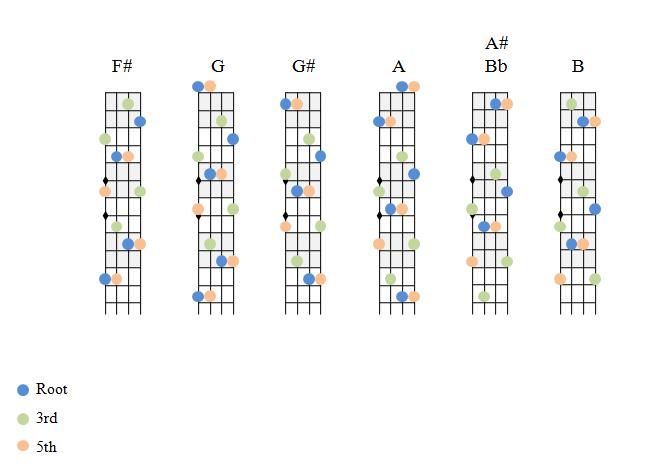
Check out my homepage photo area. I made some fiddle chord charts that show I, IV and V chords that are an easy reach of each other. There are also 2 charts of all the major chord tones.
Another useful way to learn chords is this: Go over a song or tune playing only the root of the chord, bow to match the rhythm. Do the same with the 3rd of the chord and the 5th. I found this to be a really good exercise.
 Major Chords 2 | 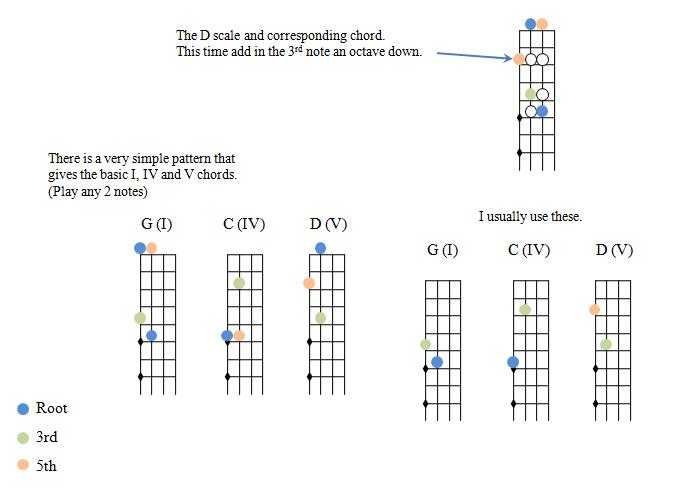 Basic Chord Patterns 3 | 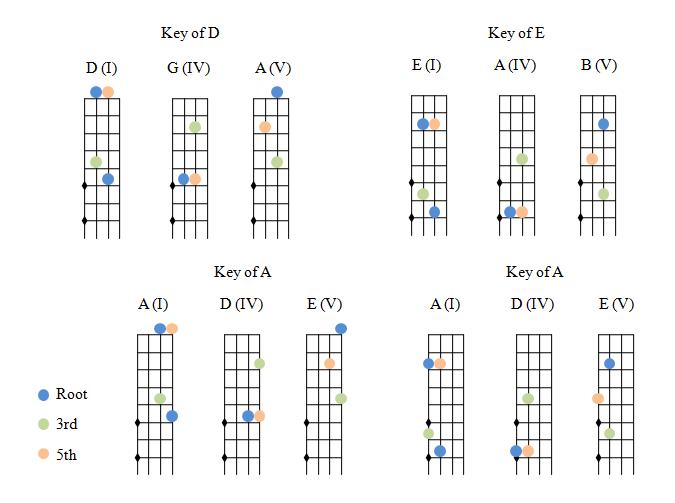 Basic Chord Patterns 4 |
paulinefiddle - Posted - 07/07/2013: 21:41:44
I just have my students figure out the arpeggios / chords for the most commonly used keys, write them down, find some good double stops there, practice them, and start using them to play along with recordings or with me. We both enjoy it, as we try different chord versions and see how we like them.
carlb - Posted - 07/08/2013: 04:02:48
fiddlehangout.com/topic/28164
There are 7 pages of double stop positions, and the chords they go with, in Miles Krassen's "Appalachian Fiddle", Oak Publications, NY, 1973, pp. 18-24.
bookfinder.com/
8 copies between $19-$30
fiddle and banjo player - Posted - 07/10/2013: 19:26:40
For any others reading along, I found this very helpful. Covers 7 common backup chords for the fiddle: youtube.com/watch?v=PB62swHzlPY
DougD - Posted - 07/11/2013: 11:01:45
Helpful maybe, but pretty basic. Also, I think its odd that she makes no distinction between the form of the C chord she chose compared to all the others. All the other chords are open fifths - just 1 and 5. This may be fine for a lot of purposes where you don't want to suggest either major or minor, but in some situations it might be a little stark. The C chord is 1 and 3, with the third on the bottom - definitely major (although in this case you could play any of the four strings). She could have just moved her "B" position up a half step to "low two" for an open fifth C chord on the A and D strings, as she did to create her F chord from the E position. (Moving up one more full step on each string pair gives a D, G, and C chord, respectively - top to bottom)
Another problem with the open string chords is its not as easy to damp them, so they may ring too long in some situations. For example, only beginning mandolin players use open chords to chop with, unless they want a particular effect.
She also didn't really mention the relationship when you move the same position across the strings. Her C chord shape moved over to the A and E strings is a very useful G chord, and moved down to the G and D strings is an F chord. Likewise, her E and B shape is an A chord on the bass strings. All the shapes move up a fifth as you go across the strings, bottom to top.
One other useful basic shape is third finger on the A string (D) and "high first finger" (F#) on the E string for a D chord. Moved down one string its a G chord, and down to the G and D strings a low C chord.
DougD - Posted - 07/11/2013: 11:30:43
BTW, I don't know if you've realized this, but if you just want open fifths, they're easy to get by stopping adjacent strings at the same place. Its just like playing scales, except you also stop and play the next higher string.
So - Naming from the lower string of the pair. Fourth string - (open) G, A, B, C, D; Third string (open) D, E, F, G, A; Second string (open) A, B, C, D, E.
Of course the sharps and flats are there too. I just left them out, but the "low one" position gives Ab, Eb, and Bb as you go across the strings.
But as I said earlier, open fifths have their limitations.
Edited by - DougD on 07/11/2013 11:34:55
wormbower - Posted - 07/21/2013: 06:34:50
Here's a question that will reveal my ignorance:
Does a chord for a particular key have to include the root as one of the two notes, or can it just contain the 3rd and 5th? For example, would a double stop B and D be considered a G chord? Or, to learn all my G chords, do I just have to learn all the G/B and G/D combinations?
Paul
DougD - Posted - 07/21/2013: 08:09:21
Kind of a fuzzy area there. Strictly speaking, a chord is usually defined as three or more notes, with the simplest being a triad (three notes): en.wikipedia.org/wiki/Chord_(music)
The double stops we're talking about here are really dyads (two notes), although as this article states, in some contexts they may still be considered a chord: en.wikipedia.org/wiki/Dyad_(music)
The problem with just two notes is that they can be ambiguous. That B/D double stop could also be part of a B minor triad (or a D6th chord). If something else is providing the root (either the melody or a bass) it will clarify things, and a 3-5 double stop works better.
Edited by - DougD on 07/21/2013 08:10:17
Verandah - Posted - 07/21/2013: 09:15:53
quote:
Originally posted by wormbower
Here's a question that will reveal my ignorance:
Does a chord for a particular key have to include the root as one of the two notes, or can it just contain the 3rd and 5th? For example, would a double stop B and D be considered a G chord? Or, to learn all my G chords, do I just have to learn all the G/B and G/D combinations?
Paul
It can be any of the chordal tones.
If you are playing with a chordal instrument like the guitar or banjo, they will carry the root tone so you are free to play any harmonies in the scale.
Learn your Scales in 3rds to start with. To do it properly you will need to be able to shift to 3rd position.
i.e. C scale starting with B on 4th string and open D 3rd string. Finger 2.
next interval. C on 4th string. E on 3rd string. Fingers 3 and 1.
Next. D on 4th string. F natural on 3rd. Fingers 4 and 2.
Heres the hard bit.
E on 4th string G on 3rd. You need to be in 3rd pos to do this. Fingers 1 and 3.
If you can get this down, the scale will follow on across the neck.
If that doesn't make sense, Google : Harmonized Scales for Violin.
wormbower - Posted - 07/21/2013: 09:36:53
Thanks, Doug and Verandah. I also found this link (can't remember if I found it here or by Googling), which looks very helpful:
musicpotential.com/fiddlestudy...hor443727
Paul
Edited by - wormbower on 07/21/2013 09:37:40
Verandah - Posted - 07/21/2013: 09:53:09
If you add another 3rd to the arpeggio you will get the 7th chord.
There is another lot of harmonies to play. And they can be quite effective.
e.g If the progression goes throught the circle...C A7 D7 G7 C. as in swing tunes,
Play the 3rd and 7th of each chord and you will find a chromatic pattern.
I'll leave that up to you. Cheers, Col.
PS. Heres a clue. Try the above progression on the 1st and 2nd strings
Edited by - Verandah on 07/21/2013 09:57:27
fiddle and banjo player - Posted - 07/22/2013: 06:26:02
quote:
Originally posted by DougD
BTW, I don't know if you've realized this, but if you just want open fifths, they're easy to get by stopping adjacent strings at the same place. Its just like playing scales, except you also stop and play the next higher string.
So - Naming from the lower string of the pair. Fourth string - (open) G, A, B, C, D; Third string (open) D, E, F, G, A; Second string (open) A, B, C, D, E.
Whew, from a person who mostly just learned by ear - this is theory overload!  But I think I understand what you mean above here Doug....Correct me if I'm wrong; Do the letters represent the note name, and you're saying when played with the next higher string open, that is a fifth, which can be used as a chord? So then would the letters also represent chord names?
martynspeck - Posted - 07/22/2013: 07:28:21
quote:
Originally posted by paulinefiddle
I just have my students figure out the arpeggios / chords for the most commonly used keys, write them down, find some good double stops there, practice them, and start using them to play along with recordings or with me. We both enjoy it, as we try different chord versions and see how we like them.
Thanks for that. I linked it to the group "Learning Jam Technique".
martynspeck - Posted - 07/22/2013: 07:33:29
quote:
Originally posted by wormbower
Here's a question that will reveal my ignorance:
Does a chord for a particular key have to include the root as one of the two notes, or can it just contain the 3rd and 5th? For example, would a double stop B and D be considered a G chord? Or, to learn all my G chords, do I just have to learn all the G/B and G/D combinations?
Paul
As I understand this, technically a chord has to contain at least 3 notes. However, since playing three notes at a time is difficult for us we tend to play just 2 of the notes of the chord in a doublestop and let the rhythm players play the rest or if playing solo the listeners ear round out the chord based on what they're expecting.
wormbower - Posted - 07/22/2013: 11:53:42
My fault for not being clear. Yes, I understand that by strict definition a chord contains at least 3 notes, and that you can (generally) only play two notes at a time on a fiddle. By "chord," I meant double-stop. What I was asking is, of the possible combinations of two notes for any major chord that you play in a double-stop, do you only have to learn the ones containing the root note (e.g., 1st & 3rd; 1st and 5th), or would it also be appropriate to play the one that contains only the 3rd & 5th, but not the root? From my further reading, it sounds like it's useful to have all of them in your quiver.
Paul
DougD - Posted - 07/22/2013: 13:38:31
fiddle and banjo player - I reread that post recently, and realized I might not have been too clear. What I meant was that since the strings on a violin are a fifth apart, any two adjacent strings will provide the root and fifth of a chord if they're played open, or both stopped at the same place. The name of the note on the lower string will also be the name of the chord. I didn't mean "when played with the next higher string open, that is a fifth" - its only a fifth if both strings are open or stopped at the same place.
You can try this just by stopping both strings with your index finger. Just considering the fourth and third strings - if they're both open the notes will be G and D (G chord). At the normal first finger position they will be A and E (A chord), second finger position will be B and F# (B chord), third finger position will be C and G (C chord), and fourth finger position will be D and A (D chord). The same thing is true for the third and fourth string pairs, and the second and first.
These are all open fifths, though, and although they may be fine for chopping, they might not provide the most pleasing harmony for double stop backup. As recent posts have mentioned, there are lots of other possibilities. The suggestion to look at mandolin chords is good too, although you'll only be able to play two strings at a time. Since I play mandolin too, I often am playing two note chords on the fiddle as a starting place, and lifting or putting down fingers to get the melody notes.
FireandAir - Posted - 07/22/2013: 13:44:50
If you are playing with a bass instrument of some sort, or one that can function as the bass foundation (piano, bass guitar or double bass violin), you're probably safe leaving out the root of the 1-3-5 chord and just playing 3-5, because it's a cinch that the root note is being played by the bass instrument already.
vrteach - Posted - 07/22/2013: 14:31:39
The layout for "two-finger mandolin chords" may also help:
mandolincafe.com/two.html
Edit: has not done me much good yet.
Edited by - vrteach on 07/22/2013 14:32:14
martynspeck - Posted - 07/23/2013: 06:27:12
quote:
Originally posted by vrteach
The layout for "two-finger mandolin chords" may also help:
mandolincafe.com/two.html
Edit: has not done me much good yet.
This is great. One question. How do I translate the 7 and 5 on the A and A7?
Verandah - Posted - 07/23/2013: 07:46:53
Martyn, the 5 and 7 refer to the fret position. I don't think Mandolin chords are that relevant to fiddle
They're inversions for 4 note chords.
In a Bluegrass band playing backup you need to be more concerned with harmonies.
DougD - Posted - 07/23/2013: 08:08:26
Yes, they're fret positions. The seventh fret is the interval of a fifth above the open string - a unison with the next higher string - what we would call the "pinky" or 4. So in the A chord the 7 on the D string is an A, with a 9 on the A string, which is an E. In the two A7 chords the 5 on the D string is a G (the seventh). In the first one, the 9 on the G string is an E, same as in the A chord. In the second one its 6 - a C#.
It might be worth mentioning that in that chart "two finger chords" mean chords using only two fingers for fretting (or stopping) but all four strings are played. This is different from the fiddle where we usually play only two notes of the chord. I agree with Verandah - some of those chords might be useful (I think I might use the G, G7, Gm, C, C7 D, and Dm forms), but some of those pairs of strings aren't going to sound very good on the fiddle.
treasurenut - Posted - 07/24/2013: 02:55:31
quote:
Originally posted by martynspeck
quote:
Originally posted by wormbower
Here's a question that will reveal my ignorance:
Does a chord for a particular key have to include the root as one of the two notes, or can it just contain the 3rd and 5th? For example, would a double stop B and D be considered a G chord? Or, to learn all my G chords, do I just have to learn all the G/B and G/D combinations?
Paul
As I understand this, technically a chord has to contain at least 3 notes. However, since playing three notes at a time is difficult for us we tend to play just 2 of the notes of the chord in a doublestop and let the rhythm players play the rest or if playing solo the listeners ear round out the chord based on what they're expecting.
When is a chord a chord? That is a tricky one! I guess us fiddle of players have decided that the 2 note chord does exist so then the question is what do we make it up with. I don't think a 2 note chord needs to have its root but when it has its root it feels a whole lot more at home and like it has a stable base. I've tried fiddling round with chords to play Blues and only came up with liking 3rds and 5ths both starting on their root. I then decided I could play all the major chords up the neck with 2 patterns and all the minor ones with 2 patterns. I added some voluntary flattened 7ths and away I went!
I've attached a couple of pages on 2 note chords from my book 'Patterns on Your Fiddle' Please take a look. I'll be interested in any feedback. jenniewilliams.com
 Fiddle 2 Note Chords |
fiddle and banjo player - Posted - 07/24/2013: 06:09:08
Thanks everyone for the continued discussion! Fiddle chords are more complicated than I thought.
As for the latest attachments, I'm still trying to figure out how to read them... 
Verandah - Posted - 07/24/2013: 07:09:53
Two notes together is a harmony.
Three notes together are a chord.
To learn the harmonies for a particular chord, play two chordal tones on adjacent strings.
For an A chord, Strings 3 and 4, 1st finger on both strings = A and E= chord tones 1 and 5.
The next harmony is Strings 3 and 4, 1st finger E on 3rd string. 3rd finger C# on 4th string. Which is chord tones 3 and 5.
Move to strings 2and 3 and play the chord tone harmonies available on those strings.
Likewise 1 and 2.
Simples!
treasurenut - Posted - 07/24/2013: 07:43:33
quote:
Originally posted by fiddle and banjo player
Thanks everyone for the continued discussion! Fiddle chords are more complicated than I thought.
As for the latest attachments, I'm still trying to figure out how to read them...
What don't you understand? I'll see if I can help I am usually very consistent with my use of colour in patterns and I notice that I have accidentally used purple for the main notes of the first pattern and pale blue for the the next ones. This may have confused you. Sorry about this - this is a work in progress!
Edited by - treasurenut on 07/24/2013 07:47:36
Terms of Use | Privacy Policy | Privacy Consent (EU/GDPR Only)
Copyright 2026 Fiddle Hangout. All Rights Reserved.


